Letter from Laurent Blessig to Madame Eliza Von der Recke

Cagliostro was a popular eighteenth century sorcerer/spiritualist/occultist/healer/freemason who, in Goethe’s time, captured the attention of many of the higher classes, including for a while, Eliza Von der Recke. Goethe’s interest in Cagliostro led to his investigating Cagliostro’s origins by visiting his supposed family in the slums of Palermo, Sicily.

Letter from Laurent Blessig to Madame Eliza Von der Recke:

“Diseases lie particularly in the blood and its distribution; the physician must also follow that. Since all nature is interblended, the physician must know it in its whole scope, and chemistry must stand at his command for solution and combination; in this, too, he must possess great knowledge. Moreover, since everything affects everything else, and this includes not only our earth, but also our whole solar system, the knowledge of the influence of the stars is indispensable to the physician. Thus Cagliostro pays much attention to the equinox, and at this season prepares most of his medicines. This mutual influence of all things is not limited to the material world; these are effects; the spirit is the cause. The spiritual world is a connected chain from which effects continually stream forth. Thus the true knower of nature is he who knows how to look up as well as down, or who stands in the same relationship to spirit as to matter. One can be initiated into this secret knowledge also in Arabia….”

Letter from Laurent Blessig to Madame Eliza Von der Recke — Dated, Strasbourg, June 7 1781 in Theosophical Path Magazine, January to December 1933. By G. De Purucker.
By the end of the Middle Ages….

“By the end of the Middle Ages, the common opinion in Europe was that celestial bodies were moved by external intelligences, identified with the angels of revelation. The outermost moving sphere, which moved with the daily motion affecting all subordinate spheres, was moved by an unmoved mover, the Prime Mover, who was identified with God. Each of the lower spheres was moved by a subordinate spiritual mover (a replacement for Aristotle’s multiple divine movers), called an intelligence.”

Pasted from <http://en.wikipedia.org/wiki/Heavenly_sphere>

Luther on Copernicus

Martin Luther (leader of the Protestant Reformation in Germany and contemporary of the real Faust) on Copernicus who unwisely showed how the Earth went around the sun and not the other way around as the Bible said:

“People gave ear to an upstart astrologer who strove to show that the earth revolves, not the heavens or the firmament, the sun and the moon….This fool wishes to reverse the entire science of astronomy; but sacred scripture tells us [Joshua 10:13]that Joshua commanded the sun to stand still, and not the earth.”

[Martin Luther in one of his “Table Talks” in 1539]

Also:

“People give ear to an upstart astrologer [Copernicus]who strove to show that the earth revolves, not the heavens or the firmament, the sun and the moon. Whoever wishes to appear clever must devise some new system, which of all systems is of course the very best. This fool wishes to reverse the entire science of astronomy.”

[Martin Luther, Works, Volume 22, c. 1543]

Pasted from <http://articles.exchristian.net/2002/04/martin-luther-quotes.php>

Although his work was known in circles, Copernicus wisely held off publication until near his death in 1543.

Luther’s friend and colleague, Philip Melanchthon (who also knew of Faust), said this in 1549:

“The eyes are witnesses that the heavens revolve in the space of twenty-four hours. But certain men, either from the love of novelty, or to make a display of ingenuity, have concluded that the earth moves; and they maintain that neither the eighth sphere [the celestial sphere] nor the sun revolves. … Now, it is a want of honesty and decency to assert such notions publicly, and the example is pernicious. It is the part of a good mind to accept the truth as revealed by God and to acquiesce in it.”

What I have done is to show that it is

Quotes from modern-day scientists:

“What I have done is to show that it is possible for the way the universe began to be determined by the laws of science. In that case, it would not be necessary to appeal to God to decide on how the universe began. This doesn’t prove that there is no God, only that God is not necessary.”
-Stephen W. Hawking (Der Spiegel, 1989)

“The most important scientific revolutions all include, as their only common feature, the dethronement of human arrogance from one pedestal after another of previous convictions about our centrality in the cosmos.”
-Stephen Jay Gould (Dinosaur in a Haystack)

Pasted from <http://www.nobeliefs.com/great-quotes.htm>

The truth is that Christian theology….

“The truth is that Christian theology, like every other theology, is not only opposed to the scientific spirit; it is also opposed to all other attempts at rational thinking. Not by accident does Genesis 3 make the father of knowledge a serpent — slimy, sneaking and abominable. Since the earliest days the church as an organization has thrown itself violently against every effort to liberate the body and mind of man. It has been, at all times and everywhere, the habitual and incorrigible defender of bad governments, bad laws, bad social theories, bad institutions. It was, for centuries, an apologist for slavery, as it was the apologist for the divine right of kings.”

H. L. Mencken

“To command the professors of astronomy to confute their own observations is to enjoin an impossibility, for it is to command them to not see what they do see, and not to understand what they do understand, and to find what they do not discover.”
Galileo Galilei, The Authority of Scripture in Philosophical Controversies

As a bonus, here’s a quote attributed to Ferdinand Magellan which is falsely attributed. He DIDN’T say this, and it seems out of character anyway:

“The church says the earth is flat, but I know that it is round, for I have seen the shadow on the moon, and I have more faith in a shadow than in the church.”

NOT by Ferdinand Magellan. Incorrectly attributed to him by Robert Green Ingersoll in his essay “Individuality” (1873)

The Church reacts to the observations of early astronomy (seventeenth

The Church reacts to the observations of early astronomy (seventeenth century Galileo Inquisition):

“The first proposition, that the sun is the center and does not revolve about the earth, is foolish, absurd, false in theology, and heretical, because contrary to Holy Scripture…the second proposition, that the earth is not the center but revolves about the sun, is absurd, false in philosophy, and, from a theological point of view at least, opposed to the true faith.” — 1615 Galileo Inquisition pronouncement.

“The opinion of the earth’s motion is of all heresies the most abominable, the most pernicious, the most scandalous; the immovability of the earth is thrice sacred; argument against the immortality of the soul, the existence of God, and the incarnation, should be tolerated sooner than the argument to prove that the earth moves.” — Jesuit Father Melchior Inchofer (1631).

“Animals, which move, have limbs and muscles; the earth has no limbs or muscles, therefore it does not move.

It is angels who make Saturn, Jupiter, the Sun, etc., turn around. If the earth revolves, it must have an angel in the centre to set it in motion; but only devils live there; it would therefore be a devil who would impart motion to the earth.

The planets, the sun, the fixed stars, all belong to one species-namely that of stars – they therefore all move or all stand still. It seems, therefore, to be a grievous wrong to place the earth, which is a sink of impurity, among these heavenly bodies, which are pure and divine things.” — Scipio Chiariamonti, associate of Cardinal Barberini.

After almost a century of steady decline…

“After almost a century of steady decline, the years from 1780 onwards witnessed the faint beginnings of a revival of astrology, for reasons which are not easy to explain. Was this revival connected in some way with Romanticism, with the cult of nature or of the past? The evidence is very slight; Goethe is probably the only serious European writer of this period to mention astrology, giving some details of his own horoscope in the course of his autobiography, yet it plays no part in his dramas, even where we might expect it, in Faust. “

P 191. Astrology: a history. By Peter Whitfield. Abrams, 2001

A Swabian Cobbler-Farmer Survives the Thirty Years War – Hans

In the area of Central Europe, including Germany, the Thirty Years War (between 1618 and 1648) was a brutal conflict over Protestant-Catholic religious and political differences. The number who died in that long war, from all manner of consequences, including famine and the plague, numbered in the millions. The historical Faust, whose fictional legend was popular about 1580, but who had died around 1541 was possibly born within Württemberg.

According to Wikipedia:

“So great was the devastation brought about by the war that estimates put the reduction of population in the German states at about 25 to 40 percent. Some regions were affected much more than others. For example, Württemberg lost three-quarters of its population during the war. In the territory of Brandenburg, the losses had amounted to half, while in some areas an estimated two-thirds of the population died. The male population of the German states was reduced by almost half. The population of the Czech lands declined by a third due to war, disease, famine and the expulsion of Protestant Czechs. Much of the destruction of civilian lives and property was caused by the cruelty and greed of mercenary soldiers. Villages were especially easy prey to the marauding armies. Those that survived, like the small village of Drais near Mainz, would take almost a hundred years to recover. The Swedish armies alone may have destroyed up to 2,000 castles, 18,000 villages and 1,500 towns in Germany, one-third of all German towns.”

https://en.wikipedia.org/wiki/Thirty_Years%27_War

From Germanhistorydocs:

A Swabian Cobbler-Farmer Survives the Thirty Years War – Hans Heberle (1597-1677):

The Great Comet and the Start of the War (1618 and 1619)

“In 1618 a great comet appeared in the form of great and terrible rod, which was accorded us by and through God because of our sinful lives, which we have richly earned in the past and continue to earn daily. “

Pasted from <http://germanhistorydocs.ghi-dc.org/sub_document.cfm?document_id=3709>

“On August 25 [1628], between one and two o’clock in the afternoon, my dear wife brought into this world for me my daughter Catherine, her first child, who was baptized that very evening during the preaching service. On that day, the sun rose at about 5:22 in the morning, and the moon stood in the sign of Scorpio.”

Pasted from <http://germanhistorydocs.ghi-dc.org/docpage.cfm?docpage_id=4404>

German History in Documents and Images (GHDI) is a comprehensive collection of primary source materials documenting Germany’s political, social, and cultural history from 1500 to the present.

Pasted from <http://germanhistorydocs.ghi-dc.org/index.cfm>

[An interesting web site, well worth pursuing]

The study of nature was pursued more for practical reasons

The study of nature, including observations of the sky, though not a higher calling, was important for practical reasons.

“The study of nature was pursued more for practical reasons than as an abstract inquiry: the need to care for the sick led to the study of medicine and of ancient texts on drugs, the need for monks to determine the proper time to pray led them to study the motion of the stars, the need to compute the date of Easter led them to study and teach rudimentary mathematics and the motions of the Sun and Moon.

Pasted from <http://en.wikipedia.org/wiki/Science_in_the_Middle_Ages>”

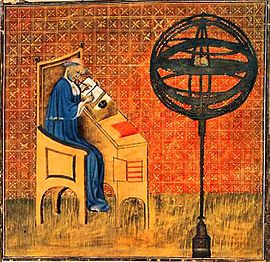
Portrait of Nicole Oresme, Thinker

Portrait of Nicole Oresme: Miniature from Oresme’s Traité de l’espere, Bibliothèque Nationale, Paris, France, fonds français 565, fol. 1r.


Pasted from <http://en.wikipedia.org/wiki/Oresme>

“Nicole Oresme c. 1320–1325 – July 11, 1382) was a significant philosopher of the later Middle Ages. He wrote influential works on economics, mathematics, physics, astrology and astronomy, philosophy, and theology; was Bishop of Lisieux, a translator, a counselor of King Charles V of France, and probably one of the most original thinkers of the 14th century.”
Pasted from <https://en.wikipedia.org/wiki/Nicole_Oresme>