What shall a man give in exchange for his soul?

What shall a man give in exchange for his soul?

Jesus says:

“And when he had called the people unto him with his disciples also, he said unto them, Whosoever will come after me, let him deny himself, and take up his cross, and follow me. For whosoever will save his life shall lose it; but whosoever shall lose his life for my sake and the gospel’s, the same shall save it. For what shall it profit a man, if he shall gain the whole world, and lose his own soul? Or what shall a man give in exchange for his soul? Whosoever therefore shall be ashamed of me and of my words in this adulterous and sinful generation; of him also shall the Son of man be ashamed, when he cometh in the glory of his Father with the holy angels.”

http://kingjbible.com/mark/8.htm

We’re not the centre of the Universe

We’re not the centre of the Universe:

Number of stars in the visible universe = 30 billion trillion (3×10²²)

(Pasted from <http://www.atlasoftheuniverse.com/universe.html>)

There are over two billion seconds in a 75-year lifetime. If that is your lifespan, then there are 12 trillion stars for every second of your life.

30,000,000,000,000 billion stars visible (there are more).
2.366820000 billion seconds = 75 years.

12,675,235,125,611.58 stars/second.

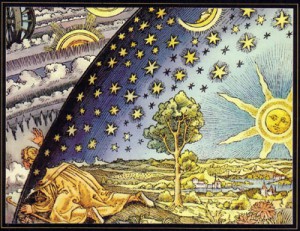
There are 12,675,235,125,612 stars per second (12.6 trillion) of a life. Each star could have a host of planets and other large bodies. In the Middle Ages, the model of the Universe had the lone Earth enclosed in spheres with God looking down from the heavens above. The Bible said that the Sun revolved around us.

The first planets outside of our solar system, while presumed to be there, were not discovered until very recently – in 1992. We’ve since discovered about 2,000. Applying estimates for our Milky Way, we might assume there are as many planets as stars. With 2,000 discovered, there are still about 30 billion trillion more. The number we have discovered is so small it has no impact on the number remaining – although finding the first was a big deal.

If God is not perched overhead, looking down on His special children, and if we are not the centre of the Universe, then what are we? What does it mean about God’s previously “revealed” truth? These were the sorts of questions faced by learned people of the time – and still. It shook their relationship with God and with the Church. Because of the import of these early discoveries, the Church was forced to act harshly in suppressing them as “errors.” They were errors because they contradicted God. To suggest that God, as reported in the Bible and as received by the Church, was wrong (or that the Church was misled and fallible) was heretical and earned death by burning.

A man peeks into the heavens
Flammarion engraving. Man peeks between heaven and the Earth to the cosmos (1888).


(If you tried to count the 12 trillion stars represented by the first second of your birth, and could count 5 per second, it would take you 80,331 years to count that first second’s stars.)

An Outline of Intellectual Rubbish

An Outline of Intellectual Rubbish
by Bertrand Russell

Pasted from <http://www.personal.kent.edu/~rmuhamma/Philosophy/RBwritings/outIntellectRubbish.htm>

…Although there are many kinds of sin, seven of which are deadly, the most fruitful field for Satan’s wiles is sex.

The orthodox Catholic doctrine on this subject is to be found in St. Paul, St. Augustine, and St. Thomas Aquinas. It is best to be celibate, but those who have not the gift of continence may marry. Intercourse in marriage is not sin, provided it is motivated by desire for offspring. All intercourse outside marriage is sin, and so is intercourse within marriage if any measures are adopted to prevent conception.

Interruption of pregnancy is sin, even if, in medical opinion, it is the only way of saving the mother’s life; for medical opinion is fallible, and God can always save a life by miracle if He sees fit. (This view is embodied in the law of Connecticut.)

Venereal disease is God’s punishment for sin. It is true that, through a guilty husband, this punishment may fall on an innocent woman and her children, but this is a mysterious dispensation of Providence, which it would be impious to question. We must also not inquire why venereal disease was not divinely instituted until the time of Columbus. Since it is the appointed penalty for sin, all measures for its avoidance are also sin-except, of course, a virtuous life.

Marriage is nominally indissoluble, but many people who seem to be married are not. In the case of influential Catholics, some ground for nullity can often be found, but for the poor there is no such outlet, except perhaps in cases of impotence. Persons who divorce and remarry are guilty of adultery in the sight of God. …

The telescope appeared to prove that a multitude of life

Developing observations in Europe seemed to show that there were worlds beyond our own Earth. While this was an idea that pre-dated Christianity, the idea that there was only one world – in accordance with Christian teachings – had been supported by the Church. Growing evidence that there must be more worlds damaged the credibility of the Church, and all ancient knowledge, including Biblical “truth.”

Cosmic pluralism, the plurality of worlds, or simply pluralism, describes the philosophical belief in numerous “worlds” in addition to Earth (possibly an infinite number), which may harbour extraterrestrial life.

The debate over pluralism began as early as the time of Anaximander (c. 610 – c. 546 BC) as an abstract metaphysical argument, long predating the scientific Copernican conception that the Earth is one of numerous planets. It has continued, in a variety of forms, until the modern era.

Pasted from <http://en.wikipedia.org/wiki/Cosmic_pluralism>

The telescope appeared to prove that a multitude of life was reasonable and an expression of God’s creative omnipotence; still powerful theological opponents, meanwhile, continued to insist that although the Earth may have been displaced from the center of the cosmos, it was still the unique focus of God’s creation. Thinkers such as Johannes Kepler were willing to admit the possibility of pluralism without truly supporting it.

Pasted from <http://en.wikipedia.org/wiki/Cosmic_pluralism>

Cosmic pluralism was a corollary to notions of infinity and the purported multitude of life-bearing worlds were more akin to parallel universes (either contemporaneously in space or infinitely recurring in time) than to different solar systems. After Thales and his student Anaximander opened the door to an infinite universe, a strong pluralist stance was adopted by the atomists, notably Leucippus, Democritus, and Epicurus. While these were prominent thinkers, their opponents—Plato and Aristotle—had greater effect. They argued that the Earth is unique and that there can be no other systems of worlds.This stance neatly dovetailed with later Christian ideas and pluralism was effectively suppressed for approximately a millennium.

Pasted from <http://en.wikipedia.org/wiki/Cosmic_pluralism>

Deism is a theological/philosophical position that combines the rejection of revelation and authority as a source of religious knowledge with the conclusion that reason and observation of the natural world are sufficient to determine the existence of a single creator of the universe.
Pasted (with modifications) from <https://en.wikipedia.org/wiki/Deism>

While many believe the United States to be founded as a Christian society, many of the leaders of the American revolution were actually influenced by deism. Benjamin Franklin, Ethan Allen, George Washington, James Madison, Thomas Jefferson, and Thomas Paine are all identified as deists.

An ancient Greek and Christianity-influenced 17th-century Europe Humanist Enlightenment era faith of nature, reason, and free-thought, Deists rejected the unreliable word of man, including the miracles and supernaturalism of the Judeo-Christian tradition in favour of their own relationship with God.

Mary Magdalene was not a prostitute….

Mary Magdalene was not a prostitute.

Mary Magdalene was not a prostitute. She is often confused with a different, unnamed woman in the Gospel of Luke (immediately before Mary Magdalene’s introduction) who indeed was a prostitute. The misconception stems from a 6th-century homily from Pope Gregory I, who assumed that the seven demons that Jesus cast out of Mary Magdalene corresponded to the still-nascent concept of the seven deadly sins.[321]

Pasted from <http://en.wikipedia.org/wiki/List_of_common_misconceptions#Human_body_and_health>

2 Corinthians 12:

Paul the Apostle tells a story of a man who went up to heaven and heard secret things.

2 Corinthians 12:

I must go on boasting. Although there is nothing to be gained, I will go on to visions and revelations from the Lord.

I know a man in Christ who fourteen years ago was caught up to the third heaven. Whether it was in the body or out of the body I do not know—God knows. And I know that this man—whether in the body or apart from the body I do not know, but God knows— was caught up to paradise.

He heard inexpressible things, things that man is not permitted to tell.

…What Faust wouldn’t hope for that? Paul goes on to tell of being plagued by the Devil:

…there was given me a sting of my flesh, an angel of Satan, to buffet me.

For which thing thrice I besought the Lord, that it might depart from me.

And he said to me: My grace is sufficient for thee; for power is made perfect in infirmity. Gladly therefore will I glory in my infirmities, that the power of Christ may dwell in me.

For which cause I please myself in my infirmities, in reproaches, in necessities, in persecutions, in distresses, for Christ. For when I am weak, then am I powerful.

Pasted from <https://www.biblegateway.com/passage/?search=2%20Corinthians%2012>