
“The Love Potion” by Evelyn de Morgan: a witch with a black cat familiar at her feet. She is carefully pouring a potion from a vial into a drinking cup.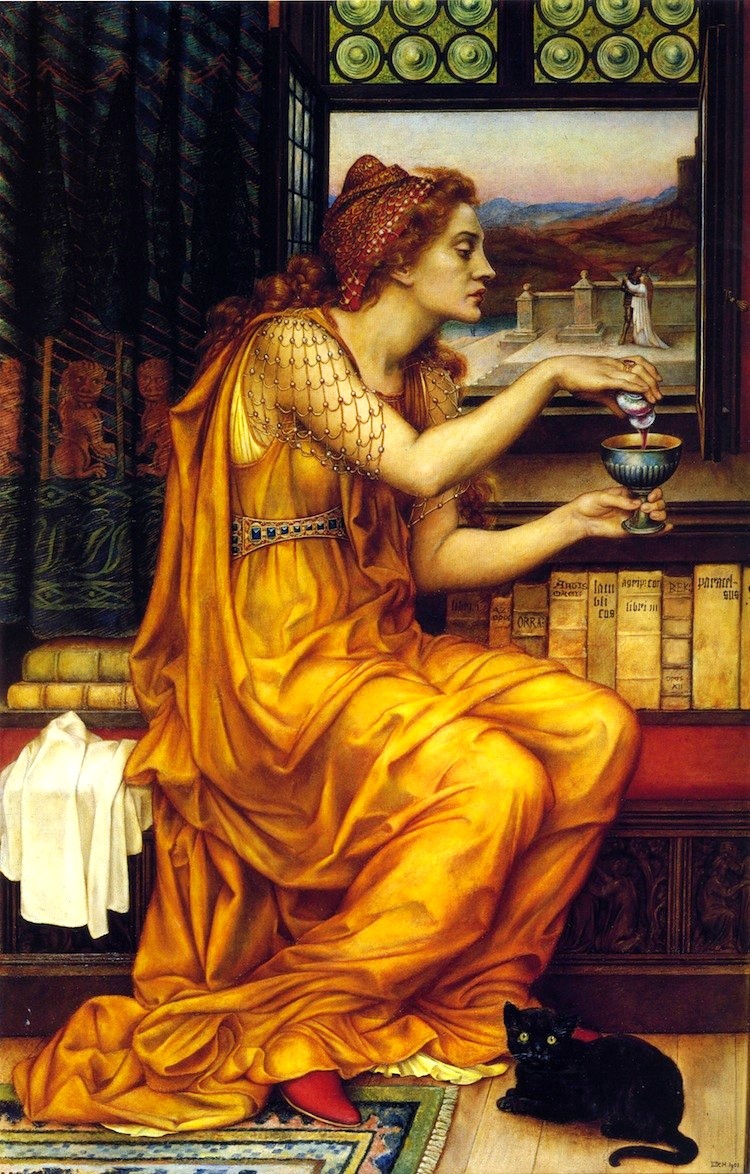
Goethe’s Intro to WALPURGIS-NIGHT
Goethe’s Intro to WALPURGIS-NIGHTTHE HARTZ MOUNTAINS.FAUST & MEPHISTOPHELES:MEPHISTOPHELESDOST thou not wish a broomstick-steed’s assistance?The sturdiest he-goat I would gladly see:The way we take, our goal is yet some distance.FAUSTSo long as in my legs I feel the fresh existence.This knotted staff suffices me.What need to shorten so the way?Along this labyrinth of vales to wander,Then climb the rocky ramparts yonder,Wherefrom the fountain flings eternal spray,Is such delight, my steps would fain delay.The spring-time stirs within the fragrant birches,And even the fir-tree feels it now:Should then our limbs escape its gentle searches? [etc.]Pasted from <http://www.gutenberg.org/files/14591/14591-8.txt>
The Witch’s Kitchen – an excerpt from Faust by Johann Wolfgang von Goethe
[An excerpt from Faust by Johann Wolfgang von Goethe, in which we meet a witch, and Mephistopheles acquires a potion for Faust’s edification. Perhaps it will bring him youth and renewed vigour. Faust reveals his prejudice and contempt for an obvious charlatan. He is an educated man, superior. These tricks are beneath him. Faust is not a witch and the things of witches – like potions – are not to his taste. Would he consider an entheogen as a legitimate route to God? Like this potion, it would surely just bring him closer to the Devil.]
THE WITCH
Wherein, Sirs, can I be of use?
MEPHISTOPHELES
Give us a goblet of the well-known juice!
But, I must beg you, of the oldest brewage;
The years a double strength produce.
THE WITCH
With all my heart! Now, here’s a bottle,
Wherefrom, sometimes, I wet my throttle,
Which, also, not the slightest, stinks;
And willingly a glass I’ll fill him.
(Whispering)
Yet, if this man without due preparation drinks,
As well thou know’st, within an hour ’twill kill him.
MEPHISTOPHELES
He is a friend of mine, with whom it will agree,
And he deserves thy kitchen’s best potation:
Come, draw thy circle, speak thine adjuration,
And fill thy goblet full and free!
THE WITCH
(with fantastic gestures draws a circle and places mysterious
articles therein; meanwhile the glasses begin to ring, the
caldron to sound, and make a musical accompaniment.
Finally she brings a great book, and stations in the circle
the Apes, who are obliged to serve as reading-desk, and to
hold the torches. She then beckons FAUST to approach.)
FAUST ( to MEPHISTOPHELES)
Now, what shall come of this? the creatures antic,
The crazy stuff, the gestures frantic,–
All the repulsive cheats I view,–
Are known to me, and hated, too.
MEPHISTOPHELES
O, nonsense! That’s a thing for laughter;
Don’t be so terribly severe!
She juggles you as doctor now, that, after,
The beverage may work the proper cheer.
( He persuades FAUST to step into the circle .)
THE WITCH
( begins to declaim, with much emphasis, from the book )
See, thus it’s done!
Make ten of one,
And two let be,
Make even three,
And rich thou ‘It be.
Cast o’er the four!
From five and six
(The witch’s tricks)
Make seven and eight,
‘Tis finished straight!
And nine is one,
And ten is none.
This is the witch’s once-one’s-one!
FAUST
She talks like one who raves in fever.
MEPHISTOPHELES
Thou’lt hear much more before we leave her.
‘Tis all the same: the book I can repeat,
Such time I’ve squandered o’er the history:
A contradiction thus complete
Is always for the wise, no less than fools, a mystery.
The art is old and new, for verily
All ages have been taught the matter,–
By Three and One, and One and Three,
Error instead of Truth to scatter.
They prate and teach, and no one interferes;
All from the fellowship of fools are shrinking.
Man usually believes, if only words he hears,
That also with them goes material for thinking!
THE WITCH ( continues )
The lofty skill
Of Science, still
From all men deeply hidden!
Who takes no thought,
To him ’tis brought,
‘Tis given unsought, unbidden!
FAUST
What nonsense she declaims before us!
My head is nigh to split, I fear:
It seems to me as if I hear
A hundred thousand fools in chorus.
MEPHISTOPHELES
O Sibyl excellent, enough of adjuration!
But hither bring us thy potation,
And quickly fill the beaker to the brim!
This drink will bring my friend no injuries:
He is a man of manifold degrees,
And many draughts are known to him.
( The WITCH, with many ceremonies, pours the drink into a
cup; as FAUST sets it to his lips, a light flame arises.)
Down with it quickly! Drain it off!
‘Twill warm thy heart with new desire:
Art with the Devil hand and glove,
And wilt thou be afraid of fire?
Pasted from <http://www.gutenberg.org/files/14591/14591-8.txt>
Peter Binsfeld
Peter BinsfeldPasted from <http://localhost/index.php/legend/seven-deadly-sins/> [This is the $%^$ who killed all those people and forced Cornelius Loos to recant (http://en.wikipedia.org/wiki/Cornelius_Loos)].He was elected Suffragan Bishop of Trier and became a well-known theologian writer, who achieved fame as a one of the most prominent witch-hunters of his time. Binsfeld wrote the influential treatise De confessionibus maleficorum et sagarum, “Of the Confessions of Warlocks and Witches”, translated into several languages (Trier, 1589). This work discussed the confessions of alleged witches, and claimed that even if such confessions were produced by torture, they should still be believed. He also encouraged denouncements.He thought that girls under age twelve and boys under age fourteen could not be considered guilty of practising witchcraft, but due to the precocity of some children the law should not be completely strict. This point of view can be considered as moderate, taking into account that other inquisitors had condemned to be burnt at the stake children between two and five years of age.Contrarily to other authors of the same time, Binsfeld doubted that people could change shape into animals and of the validity of the diabolical mark.In 1589, the same year Galileo was beginning his revolutionary experiments on bodies in motion, Binsfield published the authoritative list of demons and their associated sins, including the demons associated with the Seven Deadly Sins[1]: Lucifer (pride), Mammon (greed), Asmodeus (lust), Leviathan (envy), Beelzebub (gluttony), Satan/Amon (wrath) and Belphegor (sloth).Binsfeld’s classification of demonsPasted from <http://en.wikipedia.org/wiki/Peter_Binsfeld>
Goethe’s Faust – The First Walpurgis Night….
Goethe’s Faust – The First Walpurgis Night.THE FIRST WALPURGIS-NIGHT.A Druid:SWEET smiles the May!The forest gayFrom frost and ice is freed; No snow is found, Glad songs resound Across the verdant mead. Upon the height The snow lies light, Yet thither now we go, There to extol our Father’s name, Whom we for ages know. Amid the smoke shall gleam the flame; Thus pure the heart will grow.The Druids:Amid the smoke shall gleam the flame;Extol we now our Father’s name,Whom we for ages know!Up, up, then, let us go!One of the People: Would ye, then, so rashly act? Would ye instant death attract? Know ye not the cruel threats Of the victors we obey? Round about are plac’d their nets In the sinful heathen’s way. Ah! upon the lofty wall Wife and children slaughter they; And we all Hasten to a certain fall.Chorus of Women: Ay, upon the camp’s high wall All our children lov’d they slay. Ah, what cruel victors they! And we all Hasten to a certain fall.A Druid: Who fears to-day His rites to pay, Deserves his chains to wear. The forest’s free! This wood take we, And straight a pile prepare! Yet in the wood To stay ’tis good By day, till all is still, With watchers all around us plac’d, Protecting you from ill. With courage fresh, then, let us haste Our duties to fulfil.Chorus of Watchers:Ye valiant watchers, now divideYour numbers through the forest wide,And see that all is still,While they their rites fulfil.A Watcher: Let us, in a cunning wise, Yon dull Christian priests surprise! With the devil of their talk We’ll those very priests confound. Come with prong, and come with fork, Raise a wild and rattling sound Through the livelong night, and prowl All the rocky passes round. Screech-owl, owl, Join in chorus with our howl!Chorus of Watchers: Come with prong, and come with fork Like the devil of their talk, And with wildly rattling sound, Prowl the desert rocks around! Screech-owl, owl, Join in chorus with our howl!A Druid: Thus far ’tis right, That we by night Our Father’s praises sing; Yet when ’tis day, To Thee we may A heart unsullied bring. ’Tis true that now, And often, Thou Fav’rest the foe in fight. As from the smoke is freed the blaze, So let our faith burn bright! And if they crush our olden ways, Who e’er can crush Thy light?A Christian Watcher: Comrades, quick! your aid afford! All the brood of hell’s abroad: See how their enchanted forms Through and through with flames are glowing! Dragon-women, men-wolf swarms, On in quick succession going! Let us, let us haste to fly! Wilder yet the sounds are growing, And the arch-fiend roars on high; From the ground Hellish vapors rise around.Chorus of Christian Watchers: Terrible enchanted forms, Dragon-women, men-wolf swarms! Wilder yet the sounds are growing! See, the arch-fiend comes, all-glowing! From the ground Hellish vapors rise around.Chorus of Druids: As from the smoke is freed the blaze, So let our faith burn bright! And if they crush our olden ways, Who e’er can crush Thy light?Johann Wolfgang von Goethe, Goethe’s Works, illustrated by the best German artists, 5 vols. (Philadelphia: G. Barrie, 1885). Vol. 1. Chapter: THE FIRST WALPURGIS-NIGHT.Accessed from http://oll.libertyfund.org/title/2110/162925 on 2010-04-14
Is there virtue in sin?
Is there virtue in sin?“Lucifer and his counterpart Ahriman figure in anthroposophy as two polar, generally evil influences on world and human evolution. Steiner described both positive and negative aspects of both figures, however: Lucifer as the light spirit which “plays on human pride and offers the delusion of divinity”, but also motivates creativity and spirituality; Ahriman as the dark spirit which tempts human beings to “deny [their] link with divinity and to live entirely on the material plane“, but also stimulates intellectuality and technology. Both figures exert a negative effect on humanity when their influence becomes misplaced or one-sided, yet their influences are necessary for human freedom to unfold.”Pasted from <http://en.wikipedia.org/wiki/Anthroposophy>
Another – speculative as always – mention of Syrian Rue as an ancient entheogen
[Another—speculative as always—mention of Syrian Rue being used as an entheogen in ancient times. In this case, in the Eleusinian Mysteries.]First a short description of the Eleusinian Mysteries:
“The Eleusinian Mysteries were initiation ceremonies held every year for the cult of Demeter and Persephone based at Eleusis in ancient Greece. Of all the mysteries celebrated in ancient times, these were held to be the ones of greatest importance. These myths and mysteries, begun in the Mycenean period (c. 1600 BC) and lasting two thousand years, were a major festival during the Hellenic era, later spreading to Rome. The name of the town, Eleusís, is a variant of the noun έλευσις, éleusis, arrival.The rites, ceremonies, and beliefs were kept secret, as initiation was believed to unite the worshipper with the gods and included promises of divine power and rewards in the afterlife. There are many paintings and pieces of pottery that depict various aspects of the Mysteries. Since the Mysteries involved visions and conjuring of an afterlife, some scholars believe that the power and longevity of the Eleusinian Mysteries came from psychedelic agents.”Pasted from <http://en.wikipedia.org/wiki/Eleusinian_Mysteries>
From Wikipedia on the Greek possibly-entheogenic ritual drink Kykeon which was drunk toward the climax of the Eleusinian Mysteries:
“Another theory is that the kykeon was an Ayahuasca analog involving Syrian Rue (Peganum harmala), a shrub which grows throughout the Mediterranean and also functions as a monoamine oxidase inhibitor. The most likely candidate for the DMT containing plant, of which there are many in nature, would be species of Phalaris (grass) and/or Acacia. Other scholars however, noting the lack of any solid evidence and stressing the collective rather than individual character of initiation into the Mysteries, regard entheogenic theories with pointed skepticism. While this may be true, the Mysteries are generally accepted to be associated with the consumption of some substance(s), possibly as a beverage, that induced visions and a feeling of oneness with at least mankind, if not the universe. This made the event particularly reliable, necessarily secret, in addition to special and certainly subject to strict sanctions if the secrecy were violated.”Pasted from <http://en.wikipedia.org/wiki/Eleusinian_Mysteries>
[Barley contaminated with the LSD-ish-containing ergot fungus has also been suggested as the enthogenic substance in Kykeon. Kykeon was also known as a harmless (harmala-less?) barley-containing peasant’s drink.
Moses may have been under the influence of a hallucinogenic substance when he witnessed the burning bush
[We are intrigued by the idea that religion owes its origin to highly-convincing drugs like those found in Acacia. It’s hard not to make the connection once you read that the burning bush was supposed to be an Acacia, well known for containing DMT. Peganum harmala is Syrian rue. Syrian rue is a plant which grows in the Middle East and has long been used (thousands of years) for multiple purposes, including as a food, a red dye and as an incense.]
‘Benny Shanon, professor of cognitive psychology at the Hebrew University of Jerusalem wrote a paper, “Biblical Entheogens: a Speculative Hypothesis”, in the philosophy journal Time and Mind, which suggests Moses may have been under the influence of a hallucinogenic substance when he witnessed the burning bush. In the abstract, Shanon states that entheogens found in arid regions of the Sinai peninsula and in the south of Israel (i.e. Negev) were commonly used for religious purposes by the Israelites though he says “I have no direct proof of this interpretation,” and such proof cannot be expected.” The plants he suggests may have caused the vision are Peganum harmala, used by the Bedouin people in present times but not identified with any plant mentioned in the Bible, and acacia, mentioned frequently in the Bible, and also used in traditional Bedouin and Arab medicine. The effects of certain species of acacia are comparable to the effects of ayahuasca, which can cause users to “see music”.’
Pasted from <http://en.wikipedia.org/wiki/Burning_Bush>
Marlowe’s Seven Deadlies from The Tragedie of Doctor Faustus:
Marlowe’s Seven Deadlies from The Tragedie of Doctor Faustus:
[Mephastophilis answers Faustus’s questions about the nature of the world, but not when Faustus asks him who made the universe. Faust has doubts, and Mephastophilis and Lucifer bring in personifications of the Seven Deadly Sins (pride, covetousness, wrath, envy, gluttony, sloth, and lechery) to parade in front of Faustus.]
LUCIFER. Do so, and we will highly gratify thee. Faustus, we are
come from hell to shew thee some pastime: sit down, and thou
shalt see all the Seven Deadly Sins appear in their proper shapes.
FAUSTUS. That sight will be as pleasing unto me,
As Paradise was to Adam, the first day
Of his creation.
LUCIFER. Talk not of Paradise nor creation; but mark this show:
talk of the devil, and nothing else.—Come away!
Enter the SEVEN DEADLY SINS. Now, Faustus, examine them of their several names and dispositions.
FAUSTUS. What art thou, the first?
PRIDE. I am Pride. I disdain to have any parents. I am like to
Ovid’s flea; I can creep into every corner of a wench; sometimes,
like a perriwig, I sit upon her brow; or, like a fan of feathers,
I kiss her lips; indeed, I do—what do I not? But, fie, what a
scent is here! I’ll not speak another word, except the ground
were perfumed, and covered with cloth of arras.
FAUSTUS. What art thou, the second?
COVETOUSNESS. I am Covetousness, begotten of an old churl, in an
old leathern bag: and, might I have my wish, I would desire that
this house and all the people in it were turned to gold, that I
might lock you up in my good chest: O, my sweet gold!
FAUSTUS. What art thou, the third?
WRATH. I am Wrath. I had neither father nor mother: I leapt out
of a lion’s mouth when I was scarce half-an-hour old; and ever
since I have run up and down the world with this case
of rapiers, wounding myself when I had nobody to fight withal.
I was born in hell; and look to it, for some of you shall be
my father.
FAUSTUS. What art thou, the fourth?
ENVY. I am Envy, begotten of a chimney-sweeper and an oyster-wife.
I cannot read, and therefore wish all books were burnt. I am lean
with seeing others eat. O, that there would come a famine through
all the world, that all might die, and I live alone! then thou
shouldst see how fat I would be. But must thou sit, and I stand?
come down, with a vengeance!
FAUSTUS. Away, envious rascal!—What art thou, the fifth?
GLUTTONY. Who I, sir? I am Gluttony. My parents are all dead,
and the devil a penny they have left me, but a bare pension, and
that is thirty meals a-day and ten bevers,—a small trifle
to suffice nature. O, I come of a royal parentage! my grandfather
was a Gammon of Bacon, my grandmother a Hogshead of Claret-wine;
my godfathers were these, Peter Pickle-herring and Martin
Martlemas-beef; O, but my godmother, she was a jolly gentlewoman,
and well-beloved in every good town and city; her name was Mistress
Margery March-beer. Now, Faustus, thou hast heard all my progeny;
wilt thou bid me to supper?
FAUSTUS. No, I’ll see thee hanged: thou wilt eat up all my victuals.
GLUTTONY. Then the devil choke thee!
FAUSTUS. Choke thyself, glutton!—What art thou, the sixth?
SLOTH. I am Sloth. I was begotten on a sunny bank, where I have
lain ever since; and you have done me great injury to bring me
from thence: let me be carried thither again by Gluttony and
Lechery. I’ll not speak another word for a king’s ransom.
FAUSTUS. What are you, Mistress Minx, the seventh and last?
LECHERY. Who I, sir? I am one that loves an inch of raw mutton
better than an ell of fried stock-fish; and the first letter
of my name begins with L. FAUSTUS. Away, to hell, to hell! [Exeunt the SINS.]
Christopher Marlowe, The Tragedie of Doctor Faustus (1604 A text) Pasted from <http://www.gutenberg.org/files/779/779-h/779-h.htm>
Faustus is not a villain
Faustus is not a villainFaustus is not a villain, though; he is a tragic hero, a protagonist whose character flaws lead to his downfall. Pasted from <http://www.sparknotes.com/lit/doctorfaustus/section2.rhtml>