The history of coca – cocaine

[In the Americas, coca, the source of the drug cocaine, was important in both daily use and in religion, but ultimately incompatible with introduced Christianity. It was unknown in Europe until the 16th century, but spread slowly, first as a medicine, and ultimately as a recreational drug and entheogen. Faust would not have been familiar with it, and could well have dismissed all psychoactives as obviously illusory or demonic, and beneath him. It is worth distinguishing coca from cocaine. The purified alkaloid cocaine was not available anywhere until after 1859.]

From Wikipedia’s entry on Coca:

‘Traces of coca have been found in mummies dating 3000 years back. Other evidence dates the communal chewing of coca with lime 8000 years back. Extensive archaeological evidence for the chewing of coca leaves dates back at least to the 6th century AD Moche period, and the subsequent Inca period, based on mummies found with a supply of coca leaves, pottery depicting the characteristic cheek bulge of a coca chewer, spatulas for extracting alkali and figured bags for coca leaves and lime made from precious metals, and gold representations of coca in special gardens of the Inca in Cuzco.

Coca chewing may originally have been limited to the eastern Andes before its introduction to the Incas. As the plant was viewed as having a divine origin, its cultivation became subject to a state monopoly and its use restricted to nobles and a few favored classes (court orators, couriers, favored public workers, and the army) by the rule of the Topa Inca (1471–1493). As the Incan empire declined, the leaf became more widely available. After some deliberation, Philip II of Spain issued a decree recognizing the drug as essential to the well-being of the Andean Indians but urging missionaries to end its religious use. The Spanish are believed to have effectively encouraged use of coca by an increasing majority of the population to increase their labor output and tolerance for starvation, but it is not clear that this was planned deliberately.

Coca was first introduced to Europe in the 16th century, but did not become popular until the mid-19th century, with the publication of an influential paper by Dr. Paolo Mantegazza praising its stimulating effects on cognition. This led to invention of coca wine and the first production of pure cocaine. Coca wine (of which Vin Mariani was the best-known brand) and other coca-containing preparations were widely sold as patent medicines and tonics, with claims of a wide variety of health benefits. The original version of Coca-Cola was among these. These products became illegal in most countries outside of South America in the early 20th century, after the addictive nature of cocaine was widely recognized. In 1859, Albert Niemann of the University of Göttingen became the first person to isolate the chief alkaloid of coca, which he named “cocaine”.’

Pasted from <https://en.wikipedia.org/wiki/Coca#History>
History of cannabis

[While cannabis has been widely used for millennia, it is not always clear which cannabis was used where, and how psychoactive it might have been. Mere mention of it doesn’t mean it was necessarily used recreationally or as an entheogen (a way of finding God). Neither are the taxonomical divisions fixed. Today’s division into at least three “species” may not last long. If we are looking for evidence of its entheogenic use we can’t assume mere mention of cannabis means it was used that way, or even suited to that use.]

From Wikipedia on the history of cannabis:

Cannabis sativa appears naturally in many tropical and humid parts of the world. Its use as a mind-altering drug has been documented by archaeological finds in prehistoric societies in Euro-Asia and Africa.

The oldest written record of cannabis usage is the Greek historian Herodotus’s reference to the central Eurasian Scythians taking cannabis steam baths. His (c. 440 BCE) Histories records, “The Scythians, as I said, take some of this hemp-seed [presumably, flowers containing seeds], and, creeping under the felt coverings, throw it upon the red-hot stones; immediately it smokes, and gives out such a vapour as no Grecian vapour-bath can exceed; the Scyths, delighted, shout for joy.” Classical Greeks and Romans were using cannabis, while in the Middle East, use spread throughout the Islamic empire to North Africa. In 1545 cannabis spread to the western hemisphere where Spaniards imported it to Chile for its use as fiber. In North America cannabis, in the form of hemp, was grown for use in rope, clothing and paper.

Early classifications:


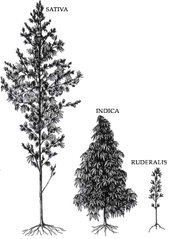
Relative size of varieties of Cannabis

The Cannabis genus was first classified using the “modern” system of taxonomic nomenclature by Carl Linnaeus in 1753, who devised the system still in use for the naming of species. He considered the genus to be monotypic, having just a single species that he named Cannabis sativa L. (L. stands for Linnaeus, and indicates the authority who first named the species). Linnaeus was familiar with European hemp, which was widely cultivated at the time. In 1785, noted evolutionary biologist Jean-Baptiste de Lamarck published a description of a second species of Cannabis, which he named Cannabis indica Lam. Lamarck based his description of the newly named species on plant specimens collected in India. He described C. indica as having poorer fiber quality than C. sativa, but greater utility as an inebriant. Additional Cannabis species were proposed in the 19th century, including strains from China and Vietnam (Indo-China) assigned the names Cannabis chinensis Delile, and Cannabis gigantea Delile ex Vilmorin. However, many taxonomists found these putative species difficult to distinguish. In the early 20th century, the single-species concept was still widely accepted, except in the Soviet Union where Cannabis continued to be the subject of active taxonomic study. The name Cannabis indica was listed in various Pharmacopoeias, and was widely used to designate Cannabis suitable for the manufacture of medicinal preparations….

Pasted from <https://en.wikipedia.org/wiki/Cannabis#History_of_cannabis>

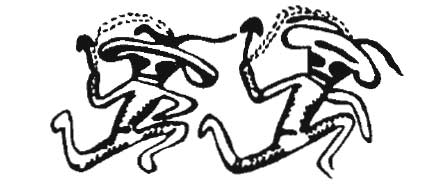
The oldest representations of hallucinogenic mushrooms in the world (Sahara Desert, 9000 -7000 B.P.)

[Entheogenic drugs have been used for thousands of years – as Wikipedia says. The term Paleolithic refers to human history between 2.6 million to 10,000 years ago, pretty much predating Judaism, and certainly before Christianity. It’s hardly surprising that our ancestors used drugs like that, and the images passed down to us are pretty convincing. 1 Psychoactive drugs are how they found god(s), accidentally or otherwise, and it must have been an extremely convincing experience. If that is our pre-historical experience, how has it subsequently passed into our own religions?]


Reproduction from Tassili rock paintings.
(For more information, see the article by Giorgio Samorini at
http://www.samorini.it/doc1/sam/sam-1992-sahara.pdf)

“Entheogenic drugs have been used by various groups for thousands of years. There are numerous historical reports as well as modern, contemporary reports of indigenous groups using entheogens, chemical substances used in a religious, shamanic, or spiritual context.”

Pasted from <https://en.wikipedia.org/wiki/Entheogenic_drugs_and_the_archaeological_record>

Old World Paleolithic:
During the Paleolithic, there is ample evidence of drug use as seen by preserved botanical remains and coprolites. Some scholars had suggested that the “Flower Burial” in Shanidar Cave, a Paleolithic site in Iraq, was evidence of a shamanic death ritual, but more recent evidence and analysis has contradicted that claim. The most direct evidence we have from the Paleolithic in terms of art comes from Tassili, Algeria. From this region, there are several therianthropic images portraying the painter and the animals around him as one (an often cited effect of many hallucinatory drugs, Ego death). One image, in particular, shows a man who has formed into one common form with a mushroom.

There are several Paleolithic sites that display therianthropic imagery. However, there is some debate as to whether or not sites like Lascaux or Chauvet were entheogenically inspired.

World religions:
There have been several reports stating that the Bible and the Vedas have several references to entheogenic drugs.

Manna and mushrooms:
Some researchers speculate that Manna, the food that the Israeli tribes harvest, was actually an entheogenic drug. The Bible as quoted in Exodus 16:14 reads:

“And when the dew that lay was gone up, behold, upon the face of the wilderness there lay a small round thing, as small as the hoar frost on the ground. And when the children of Israel saw it, they said one to another, It is manna: for they wist not what it was. And Moses said unto them, This is the bread which the Lord hath given you to eat.”

Some point to the similarities of psilocybe and the biblical description of manna as evidence.

Soma:
Main [Wikipedia] article: Botanical identity of Soma-Haoma

In regard to the Vedas, the religious texts of the Hindu religion, there has been speculation on the nature of what Soma, the food of the gods, actually was. In the Vedas it states:

“Splendid by Law! declaring Law, truth speaking, truthful in thy works, Enouncing faith, King Soma!… O [Soma] Pavāmana, place me in that deathless, undecaying world wherein the light of heaven is set, and everlasting lustre shines…. Make me immortal in that realm where happiness and transports, where joy and felicities combine….”

Amateur mycologist Robert Gordon Wasson suggested that soma is fly agaric, a mushroom commonly used by Siberian shamans, however, linguistic and ritual evidence has established that haoma was most likely a variant of Ephedra.

Pasted from <https://en.wikipedia.org/wiki/Entheogenic_drugs_and_the_archaeological_record>

[The images above are from http://www.artepreistorica.com/2009/12/the-oldest-representations-of-hallucinogenic-mushrooms-in-the-world-sahara-desert-9000-%E2%80%93-7000-b-p/ an article by Giorgio Samorini]

  1. See for example, the images at Tassili, Algeria at http://en.psilosophy.info/the_oldest_representations_of_hallucinogenic_mushrooms_in_the_world.html []

In our own time we are excited by entheogenic/psychoactive substances

[In our own time we are excited by entheogenic/psychoactive substances. It’s not unreasonable, considering we are in the rebound from more repressive times. New age religion combines with more openness and availability of entheogens and Internet-sourced information on their use to create an infatuation with entheogens and new experiences.

The term entheogen (“generating the divine within” according to Wikipedia) goes back only to 1979. Why hadn’t the term been used before? The quote from an Erowid review may sum it up best:]

“Quoting from a considerable number of pre-twentieth century accounts of accidental ingestion of psychedelic mushrooms and finding that the experience was invariably regarded as poisoning or illness, not as spiritual epiphany or gratuitous grace, Lechter contends that there is nothing intrinsic to the experience of eating psychoactive mushrooms such that people in other cultures would necessarily interpret it as valuable.”

Pasted from <https://www.erowid.org/library/review/review.php?p=263>

[Given the state of medical care in the past and the general availability of information, we don’t doubt the usual reaction on consuming entheogens in Northern Europe was not “Oh wow,” but “Oh shit.”

Perhaps the most extensive experiences with enthogens and other psychoactives were during periods of famine, which were fairly common. People were reduced to eating things we wouldn’t consider. “Tripping” may just have been a misstep followed by “falling” and “dying.”

The experience may well have been viewed as a near-death experience caused by starvation or poisoning. The survivor wouldn’t likely go looking to repeat the experience, though it could add to the folklore about death and there are certainly records of people having mystical visions which could well have been drug-induced, as well as being the symptoms of what we now classify as psychiatric disorders.]

From Wikipedia on mystical psychosis:

“Mystical psychosis is a term coined by Arthur J. Deikman in the early 1970s to characterize first-person accounts of psychotic experiences that are strikingly similar to reports of mystical experiences. According to Deikman, and authors from a number of disciplines, psychotic experience need not be considered pathological, especially if consideration is given to the values and beliefs of the individual concerned. Deikman thought the mystical experience was brought about through a “deautomatization” or undoing of habitual psychological structures that organize, limit, select, and interpret perceptual stimuli. There may be several causes of deautomatization—exposure to severe stress, substance abuse or withdrawal, and mood disorders” Pasted from <https://en.wikipedia.org/wiki/Mystical_psychosis>

[In our times do people really think they’re seeing (experiencing) God when they’re on drugs? Surely there’s always an understanding that they are on a drug, and what they are experiencing is possibly a representation of some kind. There’s always a doubt. Without dismissing the reality of an experience — if they’ve experienced it; it’s an experience, and experiences are undeniably real and can be life-changing — it’s a jump to conclude it’s more than the drugs talking. People know they’re taking a drug and that it’s the nature of a drug to alter the chemistry of the body. The term entheogen implies actual contact with divinity, and seems overly-naive.

Still if European Faustian types through the centuries – willing to do whatever it takes to find God, or gain secret knowledge – may not have seen such medications and poisons as a legitimate or useful route to God until the eighteenth century or so, why did they do so afterward?

The answer may partly lie in the fact that the parts of Europe that engendered Faust had lousy, dangerous entheogens, with the possible exception of psilocybin-containing mushrooms – and wild mushrooms aren’t always safe or palatable and lots of people avoid them. If opium and cannabis were available centuries earlier, perhaps European history would be much different.

But still, the question is answered unsatisfactorily. We may have to revisit the easy claim that religious and social repression best explain why we don’t have a history of entheogen use in northern and western Europe during the Christian period.]

We don’t have much information about any general use of psilocybin in Western Europe in past centuries

[We don’t have much information about any general use of psilocybin in Western Europe in past centuries. It wasn’t until the 1960s that there were reports of students collecting and using psilocybin-containing mushrooms as a way to get high. They were inspired by the previous decade’s publication of reports mentioned below.

Although psilocybin grows widely, the sixties phenomenon indicates that there was no remnant knowledge of use of psilocybin in European culture.]

“Psilocybin mushrooms, also known as psychedelic mushrooms, are mushrooms that contain the psychedelic compounds psilocybin and psilocin. Common colloquial terms include magic mushrooms and shrooms. It is used mainly as an entheogen and recreational drug whose effects can include euphoria, altered thinking processes, closed and open-eye visuals, synesthesia, an altered sense of time and spiritual experiences. Biological genera containing psilocybin mushrooms include Copelandia, Galerina, Gymnopilus, Inocybe, Mycena, Panaeolus, Pholiotina, Pluteus, and Psilocybe. Over 100 species are classified in the genus Psilocybe.
Psilocybin mushrooms have likely been used since prehistoric times and may have been depicted in rock art and pre-Columbian historical materials in Mesoamerica. Many cultures have used these mushrooms in their religious rites and ceremonies.”

Pasted from <https://en.wikipedia.org/wiki/Psilocybin_mushroom>


“Psilocybin is present in varying concentrations in about 200 species of Basidiomycota mushrooms. In a 2000 review on the worldwide distribution of psilocybin mushrooms, Gastón Guzmán and colleagues considered these to be distributed amongst the following genera: Psilocybe (116 species), Gymnopilus (14), Panaeolus (13), Copelandia (12), Hypholoma (6), Pluteus (6) Inocybe (6), Conocybe (4), Panaeolina (4), Gerronema (2), Agrocybe (1), Galerina (1) and Mycena (1). Guzmán increased his estimate of the number of psilocybin-containing Psilocybe to 144 species in a 2005 review.

Many of these are found in Mexico (53 species), with the remainder distributed in the US and Canada (22), Europe (16), Asia (15), Africa (4), and Australia and associated islands (19). In general, psilocybin-containing species are dark-spored, gilled mushrooms that grow in meadows and woods of the subtropics and tropics, usually in soils rich in humus and plant debris. Psilocybin mushrooms occur on all continents, but the majority of species are found in subtropical humid forests. Psilocybe species commonly found in the tropics include P. cubensis and P. subcubensis. P. semilanceata—considered by Guzmán to be the world’s most widely distributed psilocybin mushroom—is found in Europe, North America, Asia, South America, Australia and New Zealand, but is entirely absent from Mexico.”

Pasted from <https://en.wikipedia.org/wiki/Psilocybin_mushroom>

“The first reliably documented report of Psilocybe semilanceata intoxication involved a British family in 1799 (see our transcript of Doctor Brande’s report at /the-first-mention-of-hallucinogenic-mushrooms-in-european-medical-literature/), who prepared a meal with mushrooms they had picked in London’s Green Park. According to the chemist Augustus Everard Brande, the father and his four children experienced typical symptoms associated with ingestion, including pupil dilation, spontaneous laughter and delirium.”

Pasted from <https://en.wikipedia.org/wiki/Psilocybe_semilanceata>

“In 1955, Valentina and R. Gordon Wasson became the first known Caucasians to actively participate in an indigenous mushroom ceremony. The Wassons did much to publicize their discovery, even publishing an article on their experiences in Life in 1957. In 1956 Roger Heim identified the psychoactive mushroom that the Wassons had brought back from Mexico as Psilocybe, and in 1958, Albert Hofmann first identified psilocybin and psilocin as the active compounds in these mushrooms.

Inspired by the Wassons’ Life article, Timothy Leary traveled to Mexico to experience psilocybin mushrooms firsthand. Upon returning to Harvard in 1960, he and Richard Alpert started the Harvard Psilocybin Project, promoting psychological and religious study of psilocybin and other psychedelic drugs. After Leary and Alpert were dismissed by Harvard in 1963, they turned their attention toward promoting the psychedelic experience to the nascent hippie counterculture.

The popularization of entheogens by Wasson, Leary, authors Terence McKenna and Robert Anton Wilson, and others has led to an explosion in the use of psilocybin mushrooms throughout the world. By the early 1970s, many psilocybin mushroom species were described from temperate North America, Europe, and Asia and were widely collected. Books describing methods of cultivating Psilocybe cubensis in large quantities were also published. The availability of psilocybin mushrooms from wild and cultivated sources has made it among the most widely used of the psychedelic drugs.”

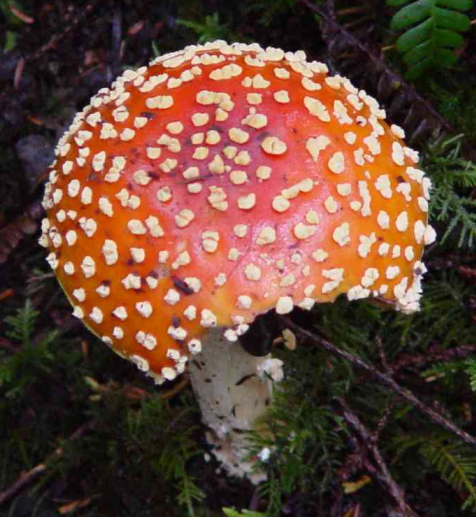
Widely considered to be a highly poisonous mushroom Amanita muscaria

[Widely considered to be a highly poisonous mushroom it was a surprise in the early 1970s when John Allegro postulated that Christianity was originally an amanita mushroom cult. To a progressively secular post-Christian society it was an intriguing idea, but to others it was an absurdity. Was this the real Christianity and had our ancestors white-washed the truth yet again? Was this evidence of a buried history of entheogenic use among Western Europeans?

In short, probably not. As mentioned below, it was used as an entheogen in Siberia, but that doesn’t extend to Western Europe and we can’t generalise. Like the datura mentioned below, the harmful effects of amanitas are very well known.

We can’t imagine a congregation using amanita, but it’s possible, even likely, that an individual could consume it and be inspired by an entheogenic experience.

The problem arises that with the dissemination of experience reports, more and more people decide that they too, would like to see God. We suggest that those people spend an appropriate amount of time digesting the negative effects of mushroom poisoning. Neither amanitas not daturas are ideal poster-boys of entheogens in Western Europe.

That said, the prehistoric use of amanitas and psilocybin (and DMT-containing substances among other entheogens ) mentioned below seems highly likely and may well have prodded us in the direction of developing languages, making them highly significant entheogens – prehistorically.]


From Wikipedia on Amanita muscaria:

Amanita muscaria, commonly known as the fly agaric or fly amanita, is a mushroom and psychoactive basidiomycete fungus, one of many in the genus Amanita. Native throughout the temperate and boreal regions of the Northern Hemisphere, Amanita muscaria has been unintentionally introduced to many countries in the Southern Hemisphere, generally as a symbiont with pine and birch plantations, and is now a true cosmopolitan species. It associates with various deciduous and coniferous trees.

This quintessential toadstool is a large white-gilled, white-spotted, usually red mushroom, and is one of the most recognisable and widely encountered in popular culture. Several subspecies with differing cap colour have been recognised, including the brown regalis (often considered a separate species), the yellow-orange flavivolvata, guessowii, formosa, and the pinkish persicina. Genetic studies published in 2006 and 2008 show several sharply delineated clades that may represent separate species.

Although classified as poisonous, reports of human deaths resulting from its ingestion are extremely rare. After parboiling—which weakens its toxicity and breaks down the mushroom’s psychoactive substances—it is eaten in parts of Europe, Asia, and North America. Amanita muscaria is noted for its hallucinogenic properties, with its main psychoactive constituent being the compound muscimol. The mushroom was used as an intoxicant and entheogen by the peoples of Siberia, and has a religious significance in these cultures. There has been much speculation on possible traditional use of this mushroom as an intoxicant in other places such as the Middle East, Eurasia, North America, and Scandinavia.”

Pasted from <https://en.wikipedia.org/wiki/Amanita_muscaria>


“Fly agarics are known for the unpredictability of their effects. Depending on habitat and the amount ingested per body weight, effects can range from nausea and twitching to drowsiness, cholinergic crisis-like effects (low blood pressure, sweating and salivation), auditory and visual distortions, mood changes, euphoria, relaxation, ataxia, and loss of equilibrium.

In cases of serious poisoning the mushroom causes delirium, somewhat similar in effect to anticholinergic poisoning (such as that caused by Datura stramonium), characterised by bouts of marked agitation with confusion, hallucinations, and irritability followed by periods of central nervous system depression. Seizures and coma may also occur in severe poisonings. Symptoms typically appear after around 30 to 90 minutes and peak within three hours, but certain effects can last for several days. In the majority of cases recovery is complete within 12 to 24 hours. The effect is highly variable between individuals, with similar doses potentially causing quite different reactions. Some people suffering intoxication have exhibited headaches up to ten hours afterwards. Retrograde amnesia and somnolence can result following recovery.”

Pasted from <https://en.wikipedia.org/wiki/Amanita_muscaria>

“The wide range of psychedelic effects can be variously described as depressant, sedative-hypnotic, dissociative, and deliriant; paradoxical effects may occur. Perceptual phenomena such as macropsia and micropsia may occur, which may have been the inspiration for the effect of mushroom-consumption in Lewis Carroll’s Alice’s Adventures in Wonderland, although “no evidence has ever been found that linked Carroll to recreational drug use”. Additionally, A. muscaria cannot be commercially cultivated, due to its mycorrhizal relationship with the roots of pine trees.”

Pasted from <https://en.wikipedia.org/wiki/Amanita_muscaria>

Philologist, archeologist, and Dead Sea Scrolls scholar John Marco Allegro postulated that early Christian theology was derived from a fertility cult revolving around the entheogenic consumption of A. muscaria in his 1970 book The Sacred Mushroom and the Cross, but his theory has found little support by scholars outside the field of ethnomycology. The book was roundly discredited by academics and theologians, including Sir Godfrey Driver, Emeritus Professor of Semitic Philology at Oxford University, and Henry Chadwick, the Dean of Christ Church, Oxford. Christian author John C. King wrote a detailed rebuttal of Allegro’s theory in the 1970 book A Christian View of the Mushroom Myth; he notes that neither fly agarics nor their host trees are found in the Middle East, even though cedars and pines are found there, and highlights the tenuous nature of the links between biblical and Sumerian names coined by Allegro. He concludes that if the theory was true, the use of the mushroom must have been “the best kept secret in the world” as it was so well concealed for two thousand years.

Pasted from <https://en.wikipedia.org/wiki/Amanita_muscaria>

…And this, from Wikipedia’s Ethnomycology:

Besides mycological determination in the field, ethnomycology depends to a large extent on anthropology and philology. One of the major debates among ethnomycologists is Wasson’s theory that the Soma mentioned in the Rigveda of the Indo-Aryans was the Amanita muscaria mushroom.

Following his example similar attempts have been made to identify psychoactive mushroom usage in many other (mostly) ancient cultures, with varying degrees of credibility. Another much written about topic is the content of the Kykeon, the sacrament used during the Eleusinian mysteries in ancient Greece between approximately 1500 BCE and 396 CE. Although not an ethnomycologist as such, philologist John Allegro has made an important contribution suggesting, in a book controversial enough to have his academic career destroyed, that Amanita muscaria was not only consumed as a sacrament but was the main focus of worship in the more esoteric sects of Sumerian religion, Judaism and early Christianity. Clark Heinrich claims that Amanita muscaria use in Europe was not completely wiped out by Orthodox Christianity but continued to be used (either consumed or merely symbolically) by individuals and small groups such as medieval Holy Grail myth makers, alchemists and Renaissance artists.

While Wasson views historical mushroom use primarily as a facilitator for the shamanic or spiritual experiences core to these rites and traditions, McKenna takes this further, positing that the ingestion of psilocybin was perhaps primary in the formation of language and culture and identifying psychedelic mushrooms as the original “Tree of Knowledge“. There is indeed some research supporting the theory that psilocybin ingestion temporarily increases neurochemical activity in the language centers of the brain, indicating a need for more research into the uses of psychoactive plants and fungi in human history.

Pasted from <https://en.wikipedia.org/wiki/Ethnomycology>

The sleep inducing medicinal plants of 17th century England

[The sleep—stupor—inducing medicinal plants of 17th century England (including opiates which were fairly new to England) were well known, as Francis Bacon (1561 – 1626) refers to them in his Natural History:]

“The ointment that witches use, is reported to be made of the fat of children digged out of their graves; of the juices of smallage, wolf bane, and cinque-foil, mingled with the meal of fine wheat. But I suppose, that the soporiferous medicines are likest to do it; which are henbane, hemlock, mandrake, moonshade, tobacco, opium, saffron, poplar leaves, etc.”

The Works of Francis Bacon: Baron of Verulam, Viscount St. Albans, and Lord High Chancellor of England, Volume 2. Pasted from <https://books.google.com/books?id=ta-8OnABVhMC>

[He refers to opiates at length here:]

“22. The Turks find opium, even in large quantities, innocent and cordial, so that they even take it before a battle to give them courage. But to us, except in small quantities, and with strong correctives, it is fatal.

23. Opium and opiates are clearly found to excite the sexual passion, which shows their power to strengthen the spirits.

24. Distilled water of the wild poppy being doubtless a mild opiate, is successfully given in surfeit, fevers, and various diseases; and let no one wonder at the variety of its use. For this is common to opiates, as the spirits being strengthened and condensed will fight against any disease.

25. The Turks use likewise a kind of herb, called “coffee,” which they dry, grind to powder, and drink in warm water. They affirm that it gives no small vigour both to their courage and their wit. Yet this taken in large quantities will excite and disturb the mind; which shows it to be of a similar nature to opiates.

26. There is a certain root, celebrated through all the Fast, called ” betel,” which the Indians and others use to carry in their mouths, and chew ; whereby they are wonderfully refreshed, and enabled to endure fatigues, and throw off disorders, and strengthened for sexual intercourse. It appears to be a kind of narcotic, because it blackens the teeth exceedingly.

27. The use of tobacco has immensely increased in our time. It affects men with a kind of secret pleasure, so that persons once accustomed to it can scarce leave it off: It tends no doubt to relieve the body, and remove weariness; and its virtue is commonly thought to lie in this, that it opens the passages and draws off the humours. But it may be more properly referred to the condensation of the spirits; for it is a kind of henbane, and manifestly affects the head, as all opiates do.

28. Humours are sometimes generated in the body, which are a kind of opiates themselves; as is found in some kinds of melancholy, wherewith if a man be seized, he is very long-lived.

29. Simple opiates, which are likewise called narcotics and stupefactives, are opium itself, which is the juice of the poppy, the plant and seed of the poppy, henbane, mandragora, hemlock, tobacco, and nightshade.

30. Compound opiates are, treacle, mithridate, trifera, laudanum of Paracelsus, diacodium, diascordium, philonium, and pills of houndstongue.

31. From these observations certain directions or advices may be drawn for the prolongation of life, according to this intention, namely, the condensing of the spirits by opiate.

32. From youth upwards, therefore, let there be every year a kind of opiate diet. Let it be taken at the end of May; for in summer the spirit: are most wasted and weakened, and there is less fear of cold humours. Let the opiate be of a superior kind, not so strong as those in use, either as to the quantity of opium or to the proportion of very hot ingredients. Let it be taken in the morning between sleeps. Let the diet at the time be more simple and sparing, without wine, spices, or things that produce vapours. Let the medicine be taken only on alternate days, and be continued for a fortnight. Such directions appear to me to answer the intention satisfactorily.

33. Opiates may not only be taken through the mouth, but likewise inhaled in the form of smoke; but it should be such as not to excite the expulsive faculty too strongly, nor draw out the humours, but only to work upon the spirits within the brain for a short time. Wherefore a suffumigation of tobacco, ligno-aloes, dried leaves of rosemary, and a little myrrh, inhaled in the morning through the mouth and nostrils, would be very beneficial.

34. In the powerful opiates, as -theriacum, mithridate, and the rest, it would not be amiss, especially in youth, to take the distilled waters rather than the bodies themselves. For in distillation the vapour rises, while the heat of the medicine generally settles; and distilled waters in the virtues conveyed by vapours are mostly good, in others weak.

35. Some medicines have a degree, weak and secret,- and therefore safe, of opiate virtue. These impart a slow and abundant vapour, but not malignant, as opiates do. And hence they do not put the spirits to flight, but yet they collect and somewhat thicken them.

36. The medicines that make opiates are, first of all saffron and its flowers; then Indian leaf, ambergris, a preparation of coriander seed, amomum and pseudamomum, lignum Rho-dium, orange-flower water, or better still, the infusion of fresh orange-flowers in oil of almonds, nutmegs pricked full of holes and soaked in rose-water.

37. Though opiates, as has been mentioned, are to be used seldom and at certain times, yet this secondary kind may be taken frequently and in daily diet, and will conduce greatly to the prolongation of life. An apothecary of Calieut, by the use of amber, is said to have lived 160 years; and the nobles of Barbary, where the common people are short-lived, are found by a use of the same means to be long-lived. Our own an-cestors, who were longer-lived than we arc, made great use of saffron, in cakes, broths, and the like. And so much for the first means of condensing the spirits; namely, by opiates and their subordinates.”

History Of Life And Death (Historia vitae et mortis). 1623. Francis Bacon. Pasted from <http://www.sirbacon.org/historylifedeath.htm>

Smoking was uncommon in sixteenth century England

[Smoking was uncommon in sixteenth century England. There is a story that a servant panicked and threw water on a tobacco-smoking Walter Raleigh, thinking he was on fire.]

Sir Francis Bacon (22 January 1561 – 9 April 1626) described tobacco:

“Tobacco comforteth the spirits, and discharged weariness, which it worketh partly by opening, but chiefly by the opiate virtue, which condenseth the spirits. It were good therefore to try the taking of fumes by pipes, as they do in tobacco, of other things; as well to dry and comfort, as for other intentions. I wish trial be made of the drying fume of rosemary, and lignum aloes, before mentioned, in pipe; and so of nutmeg, and folium indum, etc.”

The Works of Francis Bacon: Baron of Verulam, Viscount St. Albans, and Lord High Chancellor of England, Volume 2. Pasted from <https://books.google.com/books?id=ta-8OnABVhMC>

[Nutmeg is a source of a psychoactive compound, but it’s not smoked, being oily. In Elizabethan times nutmeg was thought to be good against the plague. Folium indum may be cinnamon. Lignum aloe is presumably the aromatic resin, also known as agarwood, from now rare and endangered evergreen trees in southeast Asia. Like cinnamon, it is burned in incense.]

Around the turn of the 15th century, in Spain, one of Columbus’s former crewmen smoked in his home village:

‘Jerez picked up the tobacco smoking habit. When he returned to Europe in the Niña, he introduced the habit to his home town, Ayamonte. The smoke surrounding him frightened his neighbours: the Spanish Inquisition imprisoned him for his “sinful and infernal” habits, because “only Devil could give a man the power to exhale smoke from his mouth”. When he was released seven years later, smoking tobacco had caught on.’

Pasted from <https://en.wikipedia.org/wiki/Rodrigo_de_Jerez>

Tobacco is psychoactive in its wild…

[Tobacco is psychoactive in the wild, Central/South American species (Nicotiana rustica). It was used by shamans. That isn’t quite the same tobacco smoked today, which is Nicotiana tabacum. That is thought to be a hybrid of several other species of Nicotiana.]

Nicotiana rustica is often used for entheogenic purposes by South American shamans. It contains up to nine times more nicotine than common species of Nicotiana such as Nicotiana tabacum (common tobacco). Other reasons for its shamanic use are the comparatively high levels of beta-carbolines, including the harmala alkaloids harman and norharman. Most commonly, in South American ethnobotanical preparations, it is allowed to soak or be infused in water, and the water is then insufflated into the stomach in a preparation known as singado or singa; it is also smoked in cigars, used as an enema, made into a lickable product known as ambil, and made into a snuff with the bark of a species of Theobroma, creating nu-nu. In the southeast part of Turkey, people use this herb and ashes of some tree bodies to make a moist snuff called maraş otu. They use this by putting the mixture under their lips like Swedish snus or Afghan naswar. It is also a common admixture of Ayahuasca in some parts of the Amazon.”
Pasted from <https://en.wikipedia.org/wiki/Nicotiana_rustica>

In the mid 16th century “cultivated” tobacco, Nicotiana tabacum, the tobacco we are familiar with, was imported and grown in Europe, largely as a medicinal, then progressively it became more popular for smoking.

It was already somewhat known in England when Sir Walter Raleigh helped develop a fashion for smoking among the higher classes. Raleigh was an acquaintance of both Christopher Marlowe, the playwright who wrote England’s Doctor Faustus, and John Dee, the mathematician and Hermetic philosopher known as “Elizabeth’s conjurer,” and possibly an inspiration for Marlowe’s Faustus.

Cultivated tobacco is of course, not psychoactive in palatable amounts. Its addictive qualities were recognised immediately – that’s why sailors were carrying it back from the Americas – they were already addicted. By 1610 Francis Bacon was complaining about how hard it was to quit:

“The use of tobacco has immensely increased in our time. It affects men with a kind of secret pleasure, so that persons once accustomed to it can scarce leave it off: It tends no doubt to relieve the body, and remove weariness; and its virtue is commonly thought to lie in this, that it opens the passages and draws off the humours. But it may be more properly referred to the condensation of the spirits; for it is a kind of henbane, and manifestly affects the head, as all opiates do.”
Francis Bacon, Historia vitae et mortis (1623). Pasted from <http://www.sirbacon.org/historylifedeath.htm>

In the next few centuries tobacco’s harmful nature became obvious to physicians. Francis Bacon already has his suspicions:

“It hath been observed that the diet of women with child doth work much upon the infant; as, if the mother eat quinces much, and coriander seed, the nature of both which is to repress and stay vapours that ascend to the brain, it will make the child ingenious; and on the contrary side, if the mother eat much onions or beans, or such vaporous food; or drink wine, or strong drink immoderately; or fast much; or be given to much musing; all which send or draw vapours to the head; it endangereth the child to become lunatic or of imperfect memory: and I make the same judgment of tobacco often taken by the mother.” The Works of Francis Bacon: Baron of Verulam, Viscount St. Albans, and Lord High Chancellor of England, Volume 2. Pasted from <https://books.google.com/books?id=ta-8OnABVhMC>

Mithridate and theriac-protection from poisons….

[Protection from poisons. Poisoning was a great way to get rid of your enemies – if you could get it to them. It sure beat raising an army or being hacked to death by bodyguards and you could do it without anyone suspecting it was you. With any luck, the victim would just… die, and nobody would even know it was murder. It was a great way to quietly nudge somebody out of the way without disturbing the rest of your plans.

Consequently the threat of poisoning was one which leaders throughout history faced, and there were several supposed protections against it. Foremost among them were mithridate and theriac:]

“Mithridate, also known as mithridatium, mithridatum, or mithridaticum, is a semi-mythical remedy with as many as 65 ingredients, used as an antidote for poisoning, and said to be created by Mithradates VI Eupator of Pontus in the 1st century BC. It was among one of the most complex, highly sought-after drugs during the Middle Ages and Renaissance, particularly in Italy and France, where they were in continual use for centuries. An updated recipe called theriac (Theriacum Andromachi) was known well into the 19th century.

Mithridate takes its name from its inventor, Mithradates VI, King of Pontus (134 to 63 BC) who is said to have so fortified his body against poisons with antidotes and preservatives, that when he tried to kill himself, he could not find any poison that would have an effect, and, according to some legends, had to ask a soldier to run him through with a sword. The recipe for the reputed antidote was found in his cabinet, written with his own hand, and was carried to Rome by Pompey. It was translated into Latin by Pompey’s freedman Lenaeus, and later improved upon by Nero’s physician Andromachus and Marcus Aurelius’s physician Galen. It likely underwent considerable alterations since the time of Mithradates.

In the Middle Ages, mithridate was also used as part of a regimen to ward off potential threats of plague. According to Simon Kellwaye (1593), one should “take a great Onyon, make a hole in the myddle of him, then fill the place with Mitridat or Triacle, and some leaues of Rue”. Until as late as 1786, physicians in London could officially prescribe mithridate. According to historian Christopher Hill, Oliver Cromwell took a large dose of mithridate as a precaution against the plague and found it cured his acne.”

Pasted from <https://en.wikipedia.org/wiki/Mithridate>

“According to legends, the history of theriac begins with the king Mithridates VI of Pontus who experimented with poisons and antidotes on his prisoners. His numerous toxicity experiments eventually led him to declare that he had discovered an antidote for every venomous reptile and poisonous substance. He mixed all the effective antidotes into a single one, mithridatium or mithridate. Mithridate contained opium, myrrh, saffron, ginger, cinnamon and castor, along with some forty other ingredients. When the Romans defeated him, his medical notes fell into their hands and Roman medici began to use them. Emperor Nero’s physician Andromachus improved upon mithridatum by bringing the total number of ingredients to sixty four, including viper’s flesh, a mashed decoction of which, first roasted then well aged, proved the most constant ingredient. Lise Manniche, however, links the origins of theriac to the ancient Egyptian kyphi recipe, which was also used medicinally.

Greek physician Galen devoted a whole book Theriaké to theriac. One of his patients, Roman emperor Marcus Aurelius, took it on regular basis.

In 667, ambassadors from Rûm presented the Emperor Gaozong of the Tang Dynasty in China with a theriac. The Chinese observed that it contained the gall of swine, was dark red in colour and the foreigners seemed to respect it greatly. The Tang pharmacologist Su Kung noted that it had proved its usefulness against “the hundred ailments.” Whether this panacea contained the traditional ingredients such as opium, myrrh and hemp, is not known.[

In medieval London, the preparation arrived on galleys from the Mediterranean, under the watchful eye of the Worshipful Company of Grocers. Theriac, the most expensive of medicaments, was called Venice treacle by the English apothecaries.

At the time of the Black Death in the mid 14th century, Gentile da Foligno, who died of the plague in June 1348, recommended in his plague treatise that the theriac should have been aged at least a year. Children should not ingest it, he thought, but have it rubbed on them in a salve.

In 1669, the famous French apothecary, Moyse Charas, published the formula for theriac, seeking to break the monopoly held by the Venetians at that time on the medication, thereby opening up the transfer of medical information.”

Pasted from <https://en.wikipedia.org/wiki/Theriac#Theriaca_Andromachi_Senioris<