If God can be found through the medium of any drug God is not worthy of being God

Meher Baba wrote, “If God can be found through the medium of any drug, God is not worthy of being God.”

[While not a Christian, and writing in 1966, Meher Baba succinctly sums up many Christian’s attitudes to drugs. While one may be left with an impressive, even legitimately life-changing experience, one has to question the source and can never be entirely sure it wasn’t all just an illusion. Is this a route Faust would have taken, and if so, what would the consequences have been for him? If Christianity and other religions are truly founded or shaped by drug experiences then perhaps they are the ones deceived by the Devil’s illusions (and he being one himself)—and Faust is the only rational one.]

From Wikipedia:

‘God in a Pill? Meher Baba on L.S.D. and The High Roads was a 1966 pamphlet containing messages from Meher Baba speaking out against taking illicit drugs such as marijuana and LSD, ultimately saying they were harmful “physically, mentally, and spiritually.”

The pamphlet was published in 1966 by Sufism Reoriented using quotes by Meher Baba where he disparaged the view that hallucinogenic and psychedelic drugs, especially LSD, but also marijuana, psilocybin, and other drugs, might be used to elicit meaningful spiritual insight. Meher Baba wrote, “If God can be found through the medium of any drug, God is not worthy of being God.” It was compiled from letters to several academics in the West including Allan Cohen, Robert Dreyfuss and Richard Alpert.’


Pasted from <https://en.wikipedia.org/wiki/God_in_a_Pill%3F>

Furthermore, consider this: Simulacra and Simulation. Is it just coincidence that our age of technological advancement with its “modifications” and simulations of reality is simultaneously an age of psychoactive drug use? Are entheogens just part of the simulation or a simulacrum? Are the experiences they give us real, a simulation of reality, or an experience of something that doesn’t exist?

Visionary plant use throughout the history of Christianity and before.

Judaism and Christianity / Drugs and religion. Visionary plant use throughout the history of Christianity and before.

[Few Christians would be happy to think that their religion was based on a bunch of drug experiences. Neither are they ever happy when one of their neighbours starts behaving like a lunatic. As Jesus said, “no prophet is accepted in his hometown.” We can see why. It’s hard to distinguish a prophet from a lunatic, and the neighbours appreciate a sober hard-working person who is able to care for himself and manage his responsibilities.

Whatever what their early Jewish and Christian predecessors may have thought, in Europe, occasional lunacy was a known consequence of food poisoning. During periods of famine, when starving people scrounged through the weeds and scraped the rotted grain from storage bins, drug-induced lunacy sometimes affected the whole community. It was a known thing, and given the context, people didn’t necessarily assume it was a way to reach God, except through a nasty death.

That said, following is a lengthy excerpt from Wikipedia on the possible role of drugs in early and pre-Christian times. Did groups of Christians ritually use entheogens to increase their experience of God? God only knows. Many of those alt-Catholic sects were suppressed and eliminated for their “errors,” so we may never know the extent to which today’s Christianity owes a debt to drugs. But in the face of no evidence, we really can’t honourably jump to conclusions, and have to defend against too much wild enthusiasm.

…That said. we present this excerpt from Wikipedia on Entheogens….]

“Many Christian denominations disapprove of the use of most illicit drugs. The early history of the Church, however, was filled with a variety of drug use, recreational and otherwise.

The primary advocate of a religious use of cannabis plant in early Judaism was Sula Benet, also called Sara Benetowa, a Polish anthropologist, who claimed in 1967 that the plant kaneh bosm קְנֵה-בֹשֶׂם mentioned five times in the Hebrew Bible, and used in the holy anointing oil of the Book of Exodus, was in fact cannabis. The Ethiopian Zion Coptic Church confirmed it as a possible valid interpretation. The lexicons of Hebrew and dictionaries of plants of the Bible such as by Michael Zohary (1985), Hans Arne Jensen (2004) and James A. Duke (2010) and others identify the plant in question as either Acorus calamus or Cymbopogon citratus. Kaneh-bosm is listed as an incense in the Old Testament. It is generally held by academics specializing in the archaeology and paleobotany of Ancient Israel, and those specializing in the lexicography of the Hebrew Bible that cannabis is not documented or mentioned in early Judaism. Against this some popular writers have argued that there is evidence for religious use of cannabis in the Hebrew Bible, although this hypothesis and some of the specific case studies (e.g., John Allegro in relation to Qumran, 1970) have been “widely dismissed as erroneous, others continue”.

According to The Living Torah, cannabis may have been one of the ingredients of the holy anointing oil mentioned in various sacred Hebrew texts. The herb of interest is most commonly known as kaneh-bosm (Hebrew: קְנֵה-בֹשֶׂם. This is mentioned several times in the Old Testament as a bartering material, incense, and an ingredient in holy anointing oil used by the high priest of the temple. Although Chris Bennett’s research in this area focuses on cannabis, he mentions evidence suggesting use of additional visionary plants such as henbane, as well.

The Septuagint translates kaneh-bosm as calamus, and this translation has been propagated unchanged to most later translations of the old testament. However, Polish anthropologist Sula Benet published etymological arguments that the Aramaic word for hemp can be read as kannabos and appears to be a cognate to the modern word ‘cannabis’, with the root kan meaning reed or hemp and bosm meaning fragrant. Both cannabis and calamus are fragrant, reedlike plants containing psychotropic compounds.

In his research, Professor Dan Merkur points to significant evidence of an awareness within the Jewish mystical tradition recognizing manna as an entheogen, thereby substantiating with rabbinic texts theories advanced by the superficial biblical interpretations of Terence McKenna, R. Gordon Wasson and other ethnomycologists.

Although philologist John Marco Allegro has suggested that the self-revelation and healing abilities attributed to the figure of Jesus may have been associated with the effects of the plant medicines, this evidence is dependent on pre-Septuagint interpretation of Torah and Tenach. Allegro was the only non-Catholic appointed to the position of translating the Dead Sea scrolls. His extrapolations are often the object of scorn due to Allegro’s non-mainstream theory of Jesus as a mythological personification of the essence of a “psychoactive sacrament”. Furthermore, they conflict with the position of the Catholic Church with regard to transubstantiation and the teaching involving valid matter, form, and drug — that of bread and wine (bread does not contain psychoactive drugs, but wine contains ethanol). Allegro’s book The Sacred Mushroom and the Cross relates the development of language to the development of myths, religions, and cultic practices in world cultures. Allegro believed he could prove, through etymology, that the roots of Christianity, as of many other religions, lay in fertility cults, and that cult practices, such as ingesting visionary plants (or “psychedelics”) to perceive the mind of God, persisted into the early Christian era, and to some unspecified extent into the 13th century with reoccurrences in the 18th century and mid-20th century, as he interprets the Plaincourault chapel’s fresco to be an accurate depiction of the ritual ingestion of Amanita muscaria as the Eucharist.

The historical picture portrayed by the Entheos journal is of fairly widespread use of visionary plants in early Christianity and the surrounding culture, with a gradual reduction of use of entheogens in Christianity. R. Gordon Wasson’s book Soma prints a letter from art historian Erwin Panofsky asserting that art scholars are aware of many “mushroom trees” in Christian art.

The question of the extent of visionary plant use throughout the history of Christian practice has barely been considered yet by academic or independent scholars. The question of whether visionary plants were used in pre-Theodosius Christianity is distinct from evidence that indicates the extent to which visionary plants were utilized or forgotten in later Christianity, including so-called “heretical” or “quasi-” Christian groups, and the question of other groups such as elites or laity within “orthodox” Catholic practice.

Daniel Merkur at the University of Toronto contends that a minority of Christian hermits and mystics could possibly have used entheogens, in conjunction with fasting, meditation, and prayer.”

Pasted from <https://en.wikipedia.org/wiki/Entheogen#Europe>

Some history of entheogens in Europe

[Christians may or may not have made use of entheogens – psychoactives – to see God, but the Greeks did, and so did some eastern Europeans and the people who lived and travelled through the Middle East and India, of course. ]


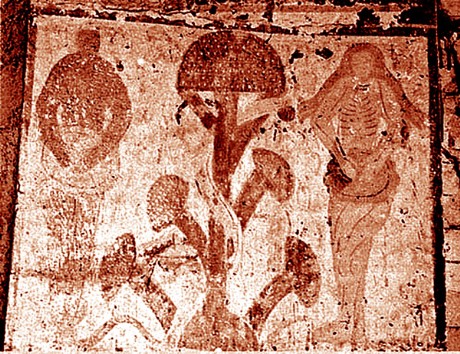
Fresco at Plaincourault Chapel. 12th c. chapel. Knights Hospitaller. Mérigny, Indre, France.

[Wikipedia on entheogens in Europe historically:]

“Fermented honey, known in Northern Europe as mead, was an early entheogen in Aegean civilization, predating the introduction of wine, which was the more familiar entheogen of the reborn Dionysus and the maenads. Its religious uses in the Aegean world are bound up with the mythology of the bee.

Dacians [Eastern Europe. Today approximately Romania – west of the Black Sea] were known to use cannabis in their religious and important life ceremonies, proven by discoveries of large clay pots with burnt cannabis seeds in ancient tombs and religious shrines. Also, local oral folklore and myths tell of ancient priests that dreamed with gods and walked in the smoke. Their names, as transmitted by Herodotus, were “kap-no-batai” which in Dacian was supposed to mean “the ones that walk in the clouds”.

The growth of Roman Christianity also saw the end of the two-thousand-year-old tradition of the Eleusinian Mysteries, the initiation ceremony for the cult of Demeter and Persephone involving the use of a drug known as kykeon. The term ‘ambrosia’ is used in Greek mythology in a way that is remarkably similar to the Soma of the Hindus as well.

A theory that natural occurring gases like ethylene used by inhalation may have played a role in divinatory ceremonies at Delphi in Classical Greece received popular press attention in the early 2000s, yet has not been conclusively proven.

Mushroom consumption is part of the culture of Europeans in general, with particular importance to Slavic and Baltic peoples. Some academics consider that using psilocybin- and or muscimol-containing mushrooms was an integral part of the ancient culture of the Rus’ people.

Middle East

It has been suggested that the ritual use of small amounts of Syrian rue is an artifact of its ancient use in higher doses as an entheogen (possibly in conjunction with DMT containing acacia).

Philologist John Marco Allegro has argued in his book The Sacred Mushroom and the Cross that early Jewish and Christian cultic practice was based on the use of Amanita muscaria, which was later forgotten by its adherents. Allegro’s hypothesis is that Amanita use was sacred knowledge kept only by high figures to hide the true beginnings of the Christian cult, seems supported by his own view that the Plaincourault Chapel shows evidence of Christian amanita use in the 13th century.”


Pasted from <https://en.wikipedia.org/wiki/Entheogen#Europe>

Psychoactive drug use can be traced to prehistory….

[We imagine some would say that historical psychoactive drug use in Christian Europe, where it was available, would be tempered by religious faith which was capable of bringing people closer to the divine – otherwise, frankly, what good was it? That someone like Faust would turn away from such an opportunity was the scandal, but for some, faith is not enough. Then again, was Faust interested in becoming closer to God? He had been that route, and was already dissatisfied. People have taken mind-altering drugs, it seems, for thousands of years with the intent of altering perception and even finding God.]

‘Psychoactive drug use can be traced to prehistory. There is archaeological evidence of the use of psychoactive substances (mostly plants) dating back at least 10,000 years, and historical evidence of cultural use over the past 5,000 years. The chewing of coca leaves, for example, dates back over 8000 years ago in Peruvian society. Medicinal use is one important facet of psychoactive drug usage. However, some have postulated that the urge to alter one’s consciousness is as primary as the drive to satiate thirst, hunger or sexual desire. Supporters of this belief contend that the history of drug use and even children’s desire for spinning, swinging, or sliding indicate that the drive to alter one’s state of mind is universal.”

One of the first people to articulate this point of view, set aside from a medicinal context, was American author Fitz Hugh Ludlow (1836–1870) in his book The Hasheesh Eater (1857):

[D]rugs are able to bring humans into the neighborhood of divine experience and can thus carry us up from our personal fate and the everyday circumstances of our life into a higher form of reality. It is, however, necessary to understand precisely what is meant by the use of drugs. We do not mean the purely physical craving…That of which we speak is something much higher, namely the knowledge of the possibility of the soul to enter into a lighter being, and to catch a glimpse of deeper insights and more magnificent visions of the beauty, truth, and the divine than we are normally able to spy through the cracks in our prison cell. But there are not many drugs which have the power of stilling such craving. The entire catalog, at least to the extent that research has thus far written it, may include only opium, hashish, and in rarer cases alcohol, which has enlightening effects only upon very particular characters.’

Pasted from <https://en.wikipedia.org/wiki/Psychoactive_drug>

[Following is the same section quoted from Archive.org’s copy. It’s trivially different we suppose, but it is different. This is from an edition from the same year (1857) as the above, which we cannot find.]

‘But there is one ground upon which the righteousness of the tendency toward stimulants may be upheld without the fear of any dangerous side issues, namely, the fact that it proves, almost as powerfully as any thing lower than direct revelation, man’s fitness by constitution and destiny by choice, for a higher set of circumstances than the present. Let it, however, be understood what, in this instance, is meant by the tendency to stimulus.

We do not mean that mere bodily craving which, shared equally in common by the most bestial and the most spiritual of men not disembodied, urges them alike to some expedient which will send their blood throbbing with a livelier thrill of physical well-being, blind them to the consideration of disagreeable truths, and eclipse all thought by the dense shadow of the Animal.

That of which we speak is something far higher — the perception of the soul’s capacity for a broader being, deeper insight, grander views of Beauty, Truth, and Good than she now gains through the chinks of her cell. It is true that there are not many stimuli which possess the power in any degree to satisfy such yearnings. The whole catalogue, so far as research has written it, will probably embrace only opium, hasheesh, and, acting upon some rarely-found combinations of temperament, liquors. ‘

Pasted from <The hasheesh eater : being passages from the life of a Pythagorean by Ludlow, Fitz Hugh, 1836-1870>

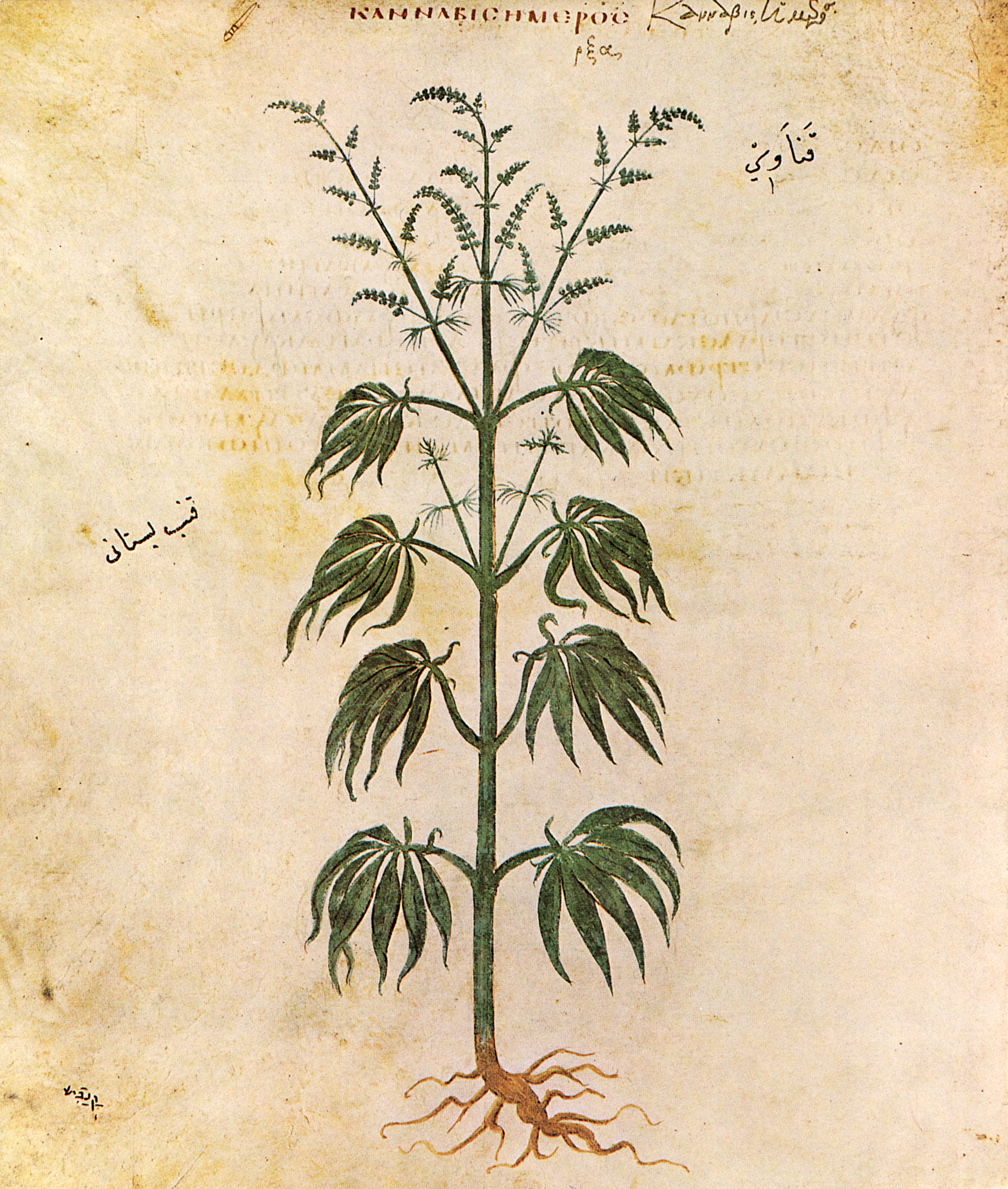
The Vienna Dioscurides or Vienna Dioscorides….

The Vienna Dioscurides or Vienna Dioscorides….

It’s a boy! A pot plant from around 512 AD. Apparently males provide better, softer fibre.]

Cannabis sativa. Illustration from the Vienna Dioscurides. 512 AD.

“The Vienna Dioscurides or Vienna Dioscorides is an early 6th-century illuminated manuscript of De Materia Medica by Dioscorides in Greek. It is an important and rare example of a late antique scientific text. The 491 vellum folios measure 37 by 30 cm and contain more than 400 pictures of animals and plants, most done in a naturalistic style.

In addition to the text by Dioscorides, the manuscript has appended to it the Carmen de herbis attributed to Rufus, a paraphrase of an ornithological treatise by a certain Dionysius, usually identified with Dionysius of Philadelphia, and a paraphrase of Nicander‘s treatise on the treatment of snake bites.”
Pasted from <https://en.wikipedia.org/wiki/Vienna_Dioscurides>

Witches’ weeds—Datura plants are often mentioned along with henbane…

[Witches’ weeds—Datura plants are often mentioned along with henbane, belladonna, mandrake and nightshade as plants used by witches for the sensation of flight and other things. All of those plants are closely related—and as closely related to the potato. While it appears the Datura (and Brugmansia) species are almost entirely American, and would have been unavailable before the fifteenth century in Europe, Datura metel was apparently known in Eurasia before Columbus, possibly since the first millennium.1

We worry about people taking Datura as a way to find God/god(s). Taking Datura is especially dangerous and unpleasant. That’s an understatement. Not referring specifically to Datura, but particulalry relevant to Datura, here’s part of what you might expect from a bad trip (according to Wikipedia):]

“… states of unrelieved terror.”

[That, and the oh-God-let-me/don’t-let-me-die physical effects including death, are worth contemplating beforehand. We think anybody thinking they’d like to meet the Devil has the wrong idea of the Devil. That probably explains why adolescents toy with Devil fantasies—innocence, ignorance and impulsiveness. Word to adolescents toying with Devil fantasies – you have to ask yourself why adults don’t do certain risky things and then consider it might be wise to wait and find out why not rather than rushing into it. You’re sure not the first try to (blank) and then (blank) with some (blank) and then (blank). Wait six years and then find out why you shouldn’t.]

Also from Wikipedia:

“All parts of Datura plants contain dangerous levels of poison and may be fatal if ingested by humans and other animals, including livestock and pets. In some places it is prohibited to buy, sell or cultivate Datura plants.”

Pasted from <https://en.wikipedia.org/wiki/Datura_inoxia>

“Datura inoxia, like other Datura species, contains the highly toxic alkaloids atropine, hyoscine (scopolamine), and hyoscyamine. The Aztecs called the plant toloatzin, and used it long before the Spanish conquest of Mexico for many therapeutic purposes, such as poultices for wounds where it acts as an anodyne. Although the Aztecs warned against madness and “various and vain imaginings”, many Native Americans have used the plant as an entheogen for hallucinations and rites of passage. The alkaloids of these plants are very similar to those of mandrake, deadly nightshade, and henbane, which are also highly poisonous plants used cautiously for effective pain relief in antiquity.

Datura intoxication typically produces a complete inability to differentiate reality from fantasy (delirium, as contrasted to hallucination); hyperthermia [rise in body temperature]; tachycardia [fast heart rate]; bizarre, and possibly violent behavior; and severe mydriasis [pupil dilation] with resultant painful photophobia that can last several days. Pronounced amnesia is another commonly reported effect. There can easily be a 5:1 variation in toxins from plant to plant, and a given plant’s toxicity depends on its age, where it is growing, and local weather conditions. These wide variations make Datura exceptionally hazardous to use as a drug. In traditional cultures, users needed to have a great deal of experience and detailed plant knowledge so that no harm resulted from using it. Such knowledge is not widely available in modern cultures, so many unfortunate incidents result from ingesting Datura. In the 1990s and 2000s, the United States media contained stories of adolescents and young adults dying or becoming seriously ill from intentionally ingesting Datura.”

Pasted from <https://en.wikipedia.org/wiki/Datura_inoxia>

“All Datura plants contain tropane alkaloids such as scopolamine, hyoscyamine, and atropine, primarily in their seeds and flowers. Because of the presence of these substances, Datura has been used for centuries in some cultures as a poison. There can be a 5:1 toxin variation between plants, and a given plant’s toxicity depends on its age, where it is growing, and the local weather conditions. These variations makes Datura exceptionally hazardous as a drug.

In traditional cultures, a great deal of experience with and detailed knowledge of Datura was critical to minimize harm. Many tragic incidents result from modern users ingesting Datura. For example, in the 1990s and 2000s, the United States media contained stories of adolescents and young adults dying or becoming seriously ill from intentionally ingesting Datura. There are also several reports in the medical literature of deaths from D. stramonium and D. ferox intoxication. Children are especially vulnerable to atropine poisoning.”

Pasted from <https://en.wikipedia.org/wiki/Datura#Toxicity>

[Having said all that, we’re not informed about any actual history of witches using Daturas or any other plants to gain the sensation of flying. Since there’s a Wikipedia page on flying ointments, and since the ingredients list is impressive enough that it must do something appropriate, we don’t doubt the stories and we expect someone’s tried it, but we don’t know who. Let us know, but for the love of God, don’t come knocking on our windows.]

  1. Geeta, R., and Waleed Gharaibeh. “Historical Evidence for a Pre-Columbian Presence of Datura in the Old World and Implications for a First Millennium Transfer from the New World.” Journal of Biosciences 32.S3 (2007): 1227-244. Web. []

A thing that comes to mind regarding psychedelics in Europe

[A thing that comes to mind regarding psychedelics in Europe and Christianity generally, is the lack of mention. On the other hand, the Greeks may have been using psychedelics for spiritual purposes in groups settings in the pre-Christian Eleusinian Mysteries.

The Eleusinian Mysteries of Greece ran for 2,000 years before they were terminated by the pro-Christian Roman emperor Theodosius 1 in 392 AD. The 2,000 year run is mentioned to suggest they held some continuing value to people. A lot of attention is focused on the secret rites and the use of a drink called kykeon. It’s suggested that the rites lasted 2,000 years because people really did have an experience of the gods, and reason why is because the drink kykeon was laced with entheogens. It’s just speculation. The secrets of the Eleusinian Mysteries may have died with the last of them.]

From Wikipedia on the Eleusinian Mysteries:

“The rites, ceremonies, and beliefs were kept secret and consistently preserved from antiquity. The initiated believed that they would have a reward in the afterlife. There are many paintings and pieces of pottery that depict various aspects of the Mysteries. Since the Mysteries involved visions and conjuring of an afterlife, some scholars believe that the power and longevity of the Eleusinian Mysteries came from psychedelic drugs.”

Pasted from <https://en.wikipedia.org/wiki/Eleusinian_Mysteries>

Entheogenic theories:

“Numerous scholars have proposed that the power of the Eleusinian Mysteries came from the kykeon’s functioning as a psychedelic agent. Use of potions or philtres for magical or religious purposes was relatively common in Greece and the ancient world. The initiates, sensitized by their fast and prepared by preceding ceremonies (see set and setting), may have been propelled by the effects of a powerful psychoactive potion into revelatory mind states with profound spiritual and intellectual ramifications. In opposition to this idea, other pointedly skeptical scholars note the lack of any solid evidence and stress the collective rather than individual character of initiation into the Mysteries. Indirect evidence in support of the entheogenic theory is that in 415 BC Athenian aristocrat Alcibiades was condemned partly because he took part in an “Eleusinian mystery” in a private house.

Many psychoactive agents have been proposed as the significant element of kykeon, though without consensus or conclusive evidence. These include the ergot, a fungal parasite of the barley or rye grain, which contains the alkaloids lysergic acid amide (LSA), a precursor to LSD, and ergonovine. However, modern attempts to prepare a kykeon using ergot-parasitized barley have yielded inconclusive results, though Alexander Shulgin and Ann Shulgin describe both ergonovine and LSA to be known to produce LSD-like effects.

Psychoactive mushrooms are another candidate. Terence McKenna speculated that the mysteries were focused around a variety of Psilocybe. Other entheogenic fungi, such as Amanita muscaria, have also been suggested. A recent hypothesis suggests that the ancient Egyptians cultivated Psilocybe cubensis on barley and associated it with the deity Osiris.

Another candidate for the psychoactive drug is an opioid derived from the poppy. The cult of the goddess Demeter may have brought the poppy from Crete to Eleusis; it is certain that opium was produced in Crete.

Another theory is that the psychoactive agent in kykeon is DMT, which occurs in many wild plants of the Mediterranean, including Phalaris and/or Acacia. To be active orally it must be combined with a monoamine oxidase inhibitor such as Syrian Rue (Peganum harmala), which grows throughout the Mediterranean.”

Pasted from <https://en.wikipedia.org/wiki/Eleusinian_Mysteries>

Forbidden fruit

Forbidden fruit

[The interesting thing about the frescoes adorning the walls of Plaincourault Abbey is that the Tree of the Knowledge of Good and Evil from the Garden of Eden, the very fruit of which opened our eyes and got us kicked out of that same garden, is represented as a psychoactive Amanita muscaria mushroom, suggesting that both the mushroom was a sacrament of the early (at least middle aged) church and that the religions of Abraham stem from early humans getting stoned and having transforming experiences that made humans what we are today. Is it possible that we owe our development as a species to hallucinogens? And if that were the case, or even seemed possible, what does it say that such substances have been so thoroughly demonized throughout the world? Are we being protected or prevented? Faust would surely have explored them, despite the prohibition of God and man, but what would he have concluded?]

From Wikipedia:

“Plaincourault Chapel is a 12th-century chapel of the Knights Hospitaller in Mérigny, Indre, France. The structure, which is located next to the Château de Plaincourault, suffered extensive damage during the French Revolution and was abandoned in 1793. It was declared a historical monument in 1944, but was not restored until the Parc naturel régional de la Brenne took ownership of the property in 1994. The chapel is famous for its unusual Romanesque art, particularly its Christian frescoes. As part of the Château de Plaincourault complex, it is designated by the French Ministry of Culture as a monument historique.”

https://en.wikipedia.org/wiki/Plaincourault_Chapel


Adam & Eve fresco (12th c+), Plaincourault Abbey, Indre, France.

[The Tree of Wisdom represented as psychoactive mushroom Amanita muscaria. Adam and Eve hide their nakedness (begging the question—if we all go naked will God be happy again? We say yes.)]

See http://merigny.pagesperso-orange.fr/lieux/chapelle.html

Also see:
John M. Allegro. The Sacred Mushroom & the Cross, 1970

[Apparently Adam and Eve were kicked out of the Garden of Eden so they wouldn’t get their hands on the fruit of the Tree of Life, gain immortality, and become “like gods.” Cherubim (plural of cherub) were stationed to prevent Adam and Eve from sneaking back in again. If the original “trees” were psychoactive drugs, then today’s police forces are taking on the role of the original cherubim.

Incidentally, these cherubs were not the fat little babies seen in art. Those are properly called putti.

Paracelsus wanted a better pharmacopeia

[Paracelsus (1493–1541) wanted a better pharmacopeia (an encyclopedia of drugs). He was a relentless and impatient iconoclast – a breaker of idols – and traditional medicine and moribund academics were his targets. It was a time for iconoclasts, and for burning same. The world was changing. This was about the time of the possible real Faust, but Paracelsus died decades before the first known manuscript.]

From Wikipedia on Paracelsus:

‘Paracelsus was well known as a difficult man. He gained a reputation for being arrogant and soon garnered the anger of other physicians in Europe. Some even claim he was a habitual drinker. He was prone to many outbursts of abusive language, abhorred untested theory, and ridiculed anybody who placed more importance on titles than practice (“if disease put us to the test, all our splendor, title, ring, and name will be as much help as a horse’s tail”).

During his time as a professor at University of Basel, he invited barber-surgeons, alchemists, apothecaries, and others lacking academic background to serve as examples of his belief that only those who practiced an art knew it: ‘The patients are your textbook, the sickbed is your study.’ He held the chair of medicine at the University of Basel and city physician for less than a year. He angered his colleagues by lecturing in German instead of Latin in order to make medical knowledge more accessible to the common people. He is credited as the first to do so. He was the first to publicly condemn the medical authority of Avicenna and Galen and threw their writings into a bonfire on St. John’s Day in 1527.

In 1526 he bought the rights of citizenship in Strasbourg to establish his own practice. But soon after he was called to Basel to the sickbed of Johann Froben or Frobenius, a successful printer and publisher. Based on historical accounts, Paracelsus cured Frobenius.

He was a contemporary of Copernicus, Leonardo da Vinci and Martin Luther. During his life, he was compared with Luther partly because his ideas were different from the mainstream and partly because of openly defiant acts against the existing authorities in medicine, such as his public burning of ancient books. This act struck people as similar to Luther’s defiance against the Church. Paracelsus rejected that comparison. Famously Paracelsus said, “I leave it to Luther to defend what he says and I will be responsible for what I say. That which you wish to Luther, you wish also to me: You wish us both in the fire.’

….

“As a physician of the early 16th century, Paracelsus held a natural affinity with the Hermetic, Neoplatonic, and Pythagorean philosophies central to the Renaissance, a world-view exemplified by Marsilio Ficino and Pico della Mirandola. Paracelsus rejected the magic theories of Heinrich Cornelius Agrippa and Nicolas Flamel in his Archidoxes of Magic. Astrology was a very important part of Paracelsus’ medicine and he was a practicing astrologer — as were many of the university-trained physicians working at this time in Europe. Paracelsus devoted several sections in his writings to the construction of astrological talismans for curing disease. He also invented an alphabet called the Alphabet of the Magi, for engraving angelic names upon talismans. Paracelsus largely rejected the philosophies of Aristotle and Galen, as well as the theory of humors. Although he did accept the concept of the four elements as water, air, fire, and earth, he saw them merely as a foundation for other properties on which to build.”

Pasted from <https://en.wikipedia.org/wiki/Paracelsus>

The witch’s flight-Decoctions of hallucinogenic plants such as

The witch’s flight

‘Decoctions of hallucinogenic plants such as henbane, belladonna, mandrake, datura, and other plants of the Solanaceae family were central to European witchcraft. All of these plants contain hallucinogenic alkaloids of the tropane family, including hyoscyamine, scopolamine, and atropine—the last of which is unusual in that it can be absorbed through the skin. These concoctions are described in the literature variously as brews, salves, ointments, philtres, oils, and unguents. Ointments were mainly applied by rubbing on the skin, especially in sensitive areas—underarms, the pubic region, the forehead, the mucous membranes of the vagina and anus, or on areas rubbed raw ahead of time. They were often first applied to a “vehicle” to be “ridden” (an object such as a broom, pitchfork, basket, or animal skin that was rubbed against sensitive skin). All of these concoctions were made and used for the purpose of giving the witch special abilities to commune with spirits, transform into animals (lycanthropy), gain love, harm enemies, experience euphoria and sexual pleasure, and—importantly—to “fly to the witches’ Sabbath”.’
From <https://en.wikipedia.org/wiki/European_witchcraft#Hallucinogens_and_witchcraft>

Witches and brooms: (From madeintransylvania.wordpress.com) “The history of the the traditional broomstick is closely tied with the “Witches Broom” of “Olde” wives tales. In early Middle Ages, many clerics had thought that witches didn’t exist – it was in fact heresy to believe that they did as it attributing divine power to a human. However, by the late Middle Ages, especially after the plague, witchcraft began to be prosecuted. During the Medieval times it became common folklore in Eastern Europe that witches used the broomsticks to fly through the air and travel great distances in short periods of time. There a few different theories trying to explain the link between broomsticks and the witches of old….” See more at: https://madeintransylvania.wordpress.com/2012/06/13/a-history-of-the-witch-and-her-broomstick/ (IA.)