Dee turns to magic….

[Like Faust, Dee has exhausted other means, and still desiring yet more knowledge, in fact, to communicate with the spirits, Dee turns to magic. He meets Edward Kelly (who appears first, not as a dog (Goethe’s Mephistopheles), but as “Edward Talbot”):]

“One Mr. Edward Talbot cam to my howse, and he being willing and desyrous to see or shew something in spirituall practise, wold have had me to have done something therein. And I truely excused myself therein: as not, in the vulgarly accownted magik, neyther studied or exercised. But confessed myself long tyme to have byn desyrous to have help in my philosophicall studies through the cumpany and information of the blessed Angels of God. And thereuppon, I brought furth to him my stone in the frame (which was given me of a frende), and I sayd unto him that I was credibly informed that to it (after a sort) were answerable Aliqui Angeli boni. And also that I was once willed by a skryer to call for the good Angel Annael to appere in that stone in my owne sight. And therefore I desyred him to call him, and (if he would) Anachor and Anilos likewise, accounted good angels, for I was not prepared thereto.

“He [Talbot] settled himself to the Action, and on his knees at my desk, setting the stone before him, fell to prayer and entreaty, etc. In the mean space, I in my Oratory did pray and make motion to God and his good creatures for the furdering of this Action. And within one quarter of an hour (or less) he had sight of one in the stone.”

John Dee by Charlotte Fell-Smith (1909)

Pasted from <http://www.johndee.org/charlotte/pdf/charlotte.pdf>
Faust, Dee and Cagliostro joined many others in the search for buried treasure

[Faust, Dee and Cagliostro joined many others in the search for buried treasure using various means including magical ones. Today we use metal detectors, aerial imagery and lidar. Buried treasure was more than a vain hope – in a time before banks, burying one’s wealth was a way to protect it while one was away – perhaps at war or in flight. Astrologers and cunning folk were employed by treasure hunters to find the hordes – but also to find (say by dowsing) natural sources of metal. Dee was sincere, Cagliostro was probably a fraud. Treasure hordes are still being discovered. From Charlotte Fell Smith:]

‘He has spent twenty years in considering the subject; people from all parts have consulted him about dreams, visions, attractions and demonstrations of “sympathia et antipathia rerum;” but it is not likely he would counsel them to proceed without permission from the State. Yet what a loss is here!

“Obscure persons, as hosiers or tanners, can, under color of seeking assays of metalls for the Saymaster, enojoy libertie to dig after dreamish demonstrations of places. May not I then, in respect of my payns, cost, and credit in matters philosophical and mathematicall, if no better or easier turn will fall to my Lot from her Majestie’s hands, may I not then be thought to mean and intend good service toward the Queen and this realm, if I will do the best I can at my own cost and charge to discover and deliver true proofe of a myne, vayn, or ore of gold or silver, in some place of her Grace’s kingdom, for her Grace’s only use?”

The Society of Royal Mines had been incorporated May 28, 1565, and the Queen had granted patents to Germans and others to dig for mines and ores. It was well known that the country abounded in hidden treasure. The valuables of the monasteries had been, in many cases, hastily buried before the last abbot was ejected at the dissolution. The subject had a special fascination for Dee, who was conscious of a “divining rod” power to discover the hiding places. He made a curious diagram of ten localities, in various counties, marked by crosses, near which he believed treasure to lie concealed. ‘

Pasted from <http://www.johndee.org/charlotte/pdf/charlotte.pdf>


Charlotte Fell Smith: John Dee’s legacy and the history of his house at Mortlake

Charlotte Fell Smith: John Dee:

[John Dee’s legacy and the history of his house at Mortlake.]

‘There is perhaps no learned author in history who has been so persistently misjudged, nay, even slandered, by his posterity, and not a voice in all the three centuries uplifted even to claim for him a fair hearing. Surely it is time that the cause of all this universal condemnation should be examined in the light of reason and science; and perhaps it will be found to exist mainly in the fact that he was too far advanced in speculative thought for his own age to understand. For more than fifty years out of the eighty-one of his life, Dee was famous, even if suspected and looked askance at as clever beyond human interpretation. Then his Queen died. With the narrow-minded Scotsman who succeeded her came a change in the fashion of men’s minds. The reign of the devil and his handmaidens — the witches and possessed persons — was set up in order to be piously overthrown, and the very bigotry of the times gave birth to independent and rational thought — to Newton, Bacon, Locke.’

Pasted from <http://www.johndee.org/charlotte/pdf/charlotte.pdf>


‘Before 1570 he took up his abode with his mother, in a house belonging to her at Mortlake, on the river Thames. It was an old rambling place, standing west of the church between it and the river. Dee added to it by degrees, purchasing small tenements adjoining, so that at length it comprised laboratories for his experiments, libraries and rooms for a busy hive of workers and servants. Mrs. Dee occupied a set of rooms of her own. Nothing of the old premises now remains, unless it be an ancient gateway leading from the garden towards the river. After Dee’s death the house passed through an interesting phase of existence, being adapted by Sir Francis Crane for the Royal tapestry works, where, encouraged by a handsome grant of money and orders from the parsimonious James, suits of hangings of beautiful workmanship were executed under the eye of Francis Cleyne, a “limner,” who was brought over from Flanders to undertake the designs. At the end of the eighteenth century, a large panelled room with red and white roses, carved and coloured, was still in existence. Early in the nineteenth century the house was used for a girls’ school, kept by a Mrs. Dubois.

Here Dee took up his abode. Its nearness to London and to the favourite places of Elizabeth’s residence — Greenwich, Hampton Court, Sion House, Isleworth, and Nonsuch — was at first considered a great advantage, and the journey to and from London was almost invariably made by water. The Queen desired her astrologer to be near at hand.’

John Dee by Charlotte Fell-Smith (1909)

Pasted from <http://www.johndee.org/charlotte/pdf/charlotte.pdf>

Wikipedia article on Kelley summarizes Dee’s interest in his angelic readings

[Wikipedia article on Kelley summarizes Dee’s interest in his angelic readings:]

‘Dee considered the dictation of angelic material highly important for three reasons. First, Dee believed the angelic represented a documentable case of true glossolalia, thereby “proving” that Kelley was actually speaking with angels and not from his imagination. Second, the angels claimed that their language was actually the original prototype of Hebrew: the language with which God spoke to Adam, and thus the first human word. Third, the angelic material takes the form of a set of conjurations that would summon an extremely powerful set of angelic beings who would reveal many secrets to those who sought them, especially the key to the philosopher’s stone, to god-like wisdom, and eternal life.’

Pasted from <https://en.wikipedia.org/wiki/Edward_Kelley>

A thing that comes to mind regarding psychedelics in Europe

[A thing that comes to mind regarding psychedelics in Europe and Christianity generally, is the lack of mention. On the other hand, the Greeks may have been using psychedelics for spiritual purposes in groups settings in the pre-Christian Eleusinian Mysteries.

The Eleusinian Mysteries of Greece ran for 2,000 years before they were terminated by the pro-Christian Roman emperor Theodosius 1 in 392 AD. The 2,000 year run is mentioned to suggest they held some continuing value to people. A lot of attention is focused on the secret rites and the use of a drink called kykeon. It’s suggested that the rites lasted 2,000 years because people really did have an experience of the gods, and reason why is because the drink kykeon was laced with entheogens. It’s just speculation. The secrets of the Eleusinian Mysteries may have died with the last of them.]

From Wikipedia on the Eleusinian Mysteries:

“The rites, ceremonies, and beliefs were kept secret and consistently preserved from antiquity. The initiated believed that they would have a reward in the afterlife. There are many paintings and pieces of pottery that depict various aspects of the Mysteries. Since the Mysteries involved visions and conjuring of an afterlife, some scholars believe that the power and longevity of the Eleusinian Mysteries came from psychedelic drugs.”

Pasted from <https://en.wikipedia.org/wiki/Eleusinian_Mysteries>

Entheogenic theories:

“Numerous scholars have proposed that the power of the Eleusinian Mysteries came from the kykeon’s functioning as a psychedelic agent. Use of potions or philtres for magical or religious purposes was relatively common in Greece and the ancient world. The initiates, sensitized by their fast and prepared by preceding ceremonies (see set and setting), may have been propelled by the effects of a powerful psychoactive potion into revelatory mind states with profound spiritual and intellectual ramifications. In opposition to this idea, other pointedly skeptical scholars note the lack of any solid evidence and stress the collective rather than individual character of initiation into the Mysteries. Indirect evidence in support of the entheogenic theory is that in 415 BC Athenian aristocrat Alcibiades was condemned partly because he took part in an “Eleusinian mystery” in a private house.

Many psychoactive agents have been proposed as the significant element of kykeon, though without consensus or conclusive evidence. These include the ergot, a fungal parasite of the barley or rye grain, which contains the alkaloids lysergic acid amide (LSA), a precursor to LSD, and ergonovine. However, modern attempts to prepare a kykeon using ergot-parasitized barley have yielded inconclusive results, though Alexander Shulgin and Ann Shulgin describe both ergonovine and LSA to be known to produce LSD-like effects.

Psychoactive mushrooms are another candidate. Terence McKenna speculated that the mysteries were focused around a variety of Psilocybe. Other entheogenic fungi, such as Amanita muscaria, have also been suggested. A recent hypothesis suggests that the ancient Egyptians cultivated Psilocybe cubensis on barley and associated it with the deity Osiris.

Another candidate for the psychoactive drug is an opioid derived from the poppy. The cult of the goddess Demeter may have brought the poppy from Crete to Eleusis; it is certain that opium was produced in Crete.

Another theory is that the psychoactive agent in kykeon is DMT, which occurs in many wild plants of the Mediterranean, including Phalaris and/or Acacia. To be active orally it must be combined with a monoamine oxidase inhibitor such as Syrian Rue (Peganum harmala), which grows throughout the Mediterranean.”

Pasted from <https://en.wikipedia.org/wiki/Eleusinian_Mysteries>

Forbidden fruit

Forbidden fruit

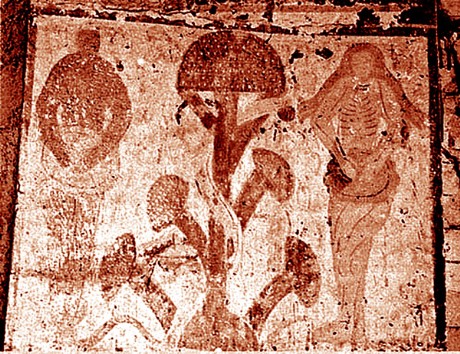
[The interesting thing about the frescoes adorning the walls of Plaincourault Abbey is that the Tree of the Knowledge of Good and Evil from the Garden of Eden, the very fruit of which opened our eyes and got us kicked out of that same garden, is represented as a psychoactive Amanita muscaria mushroom, suggesting that both the mushroom was a sacrament of the early (at least middle aged) church and that the religions of Abraham stem from early humans getting stoned and having transforming experiences that made humans what we are today. Is it possible that we owe our development as a species to hallucinogens? And if that were the case, or even seemed possible, what does it say that such substances have been so thoroughly demonized throughout the world? Are we being protected or prevented? Faust would surely have explored them, despite the prohibition of God and man, but what would he have concluded?]

From Wikipedia:

“Plaincourault Chapel is a 12th-century chapel of the Knights Hospitaller in Mérigny, Indre, France. The structure, which is located next to the Château de Plaincourault, suffered extensive damage during the French Revolution and was abandoned in 1793. It was declared a historical monument in 1944, but was not restored until the Parc naturel régional de la Brenne took ownership of the property in 1994. The chapel is famous for its unusual Romanesque art, particularly its Christian frescoes. As part of the Château de Plaincourault complex, it is designated by the French Ministry of Culture as a monument historique.”

https://en.wikipedia.org/wiki/Plaincourault_Chapel


Adam & Eve fresco (12th c+), Plaincourault Abbey, Indre, France.

[The Tree of Wisdom represented as psychoactive mushroom Amanita muscaria. Adam and Eve hide their nakedness (begging the question—if we all go naked will God be happy again? We say yes.)]

See http://merigny.pagesperso-orange.fr/lieux/chapelle.html

Also see:
John M. Allegro. The Sacred Mushroom & the Cross, 1970

[Apparently Adam and Eve were kicked out of the Garden of Eden so they wouldn’t get their hands on the fruit of the Tree of Life, gain immortality, and become “like gods.” Cherubim (plural of cherub) were stationed to prevent Adam and Eve from sneaking back in again. If the original “trees” were psychoactive drugs, then today’s police forces are taking on the role of the original cherubim.

Incidentally, these cherubs were not the fat little babies seen in art. Those are properly called putti.

Paracelsus wanted a better pharmacopeia

[Paracelsus (1493–1541) wanted a better pharmacopeia (an encyclopedia of drugs). He was a relentless and impatient iconoclast – a breaker of idols – and traditional medicine and moribund academics were his targets. It was a time for iconoclasts, and for burning same. The world was changing. This was about the time of the possible real Faust, but Paracelsus died decades before the first known manuscript.]

From Wikipedia on Paracelsus:

‘Paracelsus was well known as a difficult man. He gained a reputation for being arrogant and soon garnered the anger of other physicians in Europe. Some even claim he was a habitual drinker. He was prone to many outbursts of abusive language, abhorred untested theory, and ridiculed anybody who placed more importance on titles than practice (“if disease put us to the test, all our splendor, title, ring, and name will be as much help as a horse’s tail”).

During his time as a professor at University of Basel, he invited barber-surgeons, alchemists, apothecaries, and others lacking academic background to serve as examples of his belief that only those who practiced an art knew it: ‘The patients are your textbook, the sickbed is your study.’ He held the chair of medicine at the University of Basel and city physician for less than a year. He angered his colleagues by lecturing in German instead of Latin in order to make medical knowledge more accessible to the common people. He is credited as the first to do so. He was the first to publicly condemn the medical authority of Avicenna and Galen and threw their writings into a bonfire on St. John’s Day in 1527.

In 1526 he bought the rights of citizenship in Strasbourg to establish his own practice. But soon after he was called to Basel to the sickbed of Johann Froben or Frobenius, a successful printer and publisher. Based on historical accounts, Paracelsus cured Frobenius.

He was a contemporary of Copernicus, Leonardo da Vinci and Martin Luther. During his life, he was compared with Luther partly because his ideas were different from the mainstream and partly because of openly defiant acts against the existing authorities in medicine, such as his public burning of ancient books. This act struck people as similar to Luther’s defiance against the Church. Paracelsus rejected that comparison. Famously Paracelsus said, “I leave it to Luther to defend what he says and I will be responsible for what I say. That which you wish to Luther, you wish also to me: You wish us both in the fire.’

….

“As a physician of the early 16th century, Paracelsus held a natural affinity with the Hermetic, Neoplatonic, and Pythagorean philosophies central to the Renaissance, a world-view exemplified by Marsilio Ficino and Pico della Mirandola. Paracelsus rejected the magic theories of Heinrich Cornelius Agrippa and Nicolas Flamel in his Archidoxes of Magic. Astrology was a very important part of Paracelsus’ medicine and he was a practicing astrologer — as were many of the university-trained physicians working at this time in Europe. Paracelsus devoted several sections in his writings to the construction of astrological talismans for curing disease. He also invented an alphabet called the Alphabet of the Magi, for engraving angelic names upon talismans. Paracelsus largely rejected the philosophies of Aristotle and Galen, as well as the theory of humors. Although he did accept the concept of the four elements as water, air, fire, and earth, he saw them merely as a foundation for other properties on which to build.”

Pasted from <https://en.wikipedia.org/wiki/Paracelsus>

The rising class of technological adepts – these “mecanicians”

[The rising class of technological adepts – these “mecanicians” – wanted to increase and improve their skills. They sought out learning, not unlike those a hundred (?) years earlier who flocked to classes on literacy when the printing press spread the printed word – in the local languages (not Latin) – throughout Europe. Not long ago, in a similar fashion, people “flocked” to computer courses.]

It should be noted, though, that Dee’s understanding of the role of mathematics is radically different from our contemporary view. Dee’s promotion of mathematics outside the universities was an enduring practical achievement. As with most of his writings, Dee chose to write in English, rather than Latin, to make his writings accessible to the general public. His “Mathematical Preface” to Euclid was meant to promote the study and application of mathematics by those without a university education, and was very popular and influential among the “mecanicians”: the new and growing class of technical craftsmen and artisans. Dee’s preface included demonstrations of mathematical principles that readers could perform themselves without special education or training.

Pasted from <https://en.wikipedia.org/wiki/John_Dee>

John Dee’s motivations – and methods – were not much different from Faust’s

[John Dee’s motivations were not much different from Faust’s:]

‘A student of the Renaissance Neo-Platonism of Marsilio Ficino, Dee did not draw distinctions between his mathematical research and his investigations into Hermetic magic, angel summoning and divination. Instead he considered all of his activities to constitute different facets of the same quest: the search for a transcendent understanding of the divine forms which underlie the visible world, which Dee called “pure verities”.’

Pasted from <https://en.wikipedia.org/wiki/John_Dee>

“Dee, on the other hand, was more interested in communicating with the angels whom he believed would help him solve the mysteries of the heavens through mathematics, optics, astrology, science and navigation.”

Pasted from <https://en.wikipedia.org/wiki/John_Dee#Final_years>

The Hieroglyphic embodies Dee’s vision of the unity of the Cosmos

“The Hieroglyphic embodies Dee’s vision of the unity of the Cosmos and is a composite of various esoteric and astrological symbols.” From Wikipedia:

“The Monas Hieroglyphica (or Hieroglyphic Monad) is an esoteric symbol invented and designed by John Dee, the Elizabethan Magus and Court Astrologer of Elizabeth I of England. It is also the title of the 1564 book in which Dee expounds the meaning of his symbol.

(Dee’s glyph, whose meaning he explained in Monas Hieroglyphica as representing (from top to bottom): the moon; the sun; the elements; and fire.)


The Hieroglyphic embodies Dee’s vision of the unity of the Cosmos and is a composite of various esoteric and astrological symbols. Dee wrote a commentary on it which serves as a primer of its mysteries. However, the obscurity of the commentary is such that it is believed that Dee used it as a sort of textbook for a more detailed explanation of the Hieroglyph which he would give in person. In the absence of any remaining detail of this explanation we may never know the full significance of the Glyph.

[…]

The existence of the Hieroglyph links Dee to Rosicrucianism but in what way remains obscure. The Hieroglyph appears on a page of the Rosicrucian Manifesto Chymical Wedding of Christian Rosenkreutz, beside the text of the invitation to the Royal Wedding given to Rosenkreutz who narrates the work. It is indeed at least possible that Dee showed the Glyph to Johannes Valentinus Andreae or even an associate during one of his visits to Central Europe. However, whether Andrae’s claims of authoring the treatise hold any weight is still a hotly debated question among scholars.”

Pasted from <https://en.wikipedia.org/wiki/Monas_Hieroglyphica>