There was a hissing sound and a slight effervescence

“There was a hissing sound and a slight effervescence, and after fifteen minutes, Helvetius found that the lead had been transformed into the finest gold, which on cooling, glittered and shone as gold indeed. A goldsmith to whom he took this declared it to be the purest gold that he had ever seen and offered to buy it at fifty florins per ounce. Amongst others, the Controller of the Mint came to examine the gold and asked that a small part might be placed at his disposal for examination. Being put through the tests with aqua fortis and antimony it was pronounced pure gold of the finest quality.”

History of Alchemy from Ancient Egypt to Modern Times: Alchemy Rediscovered and Restored, by A. Cockren (1940).

17th century alchemist John Frederick Helvetius (Johann Friedrich Schweitzer(1625-1709)), Dutch physician and alchemical writer, claimed to have carried out the transmutation of lead into gold.

I made a projection of my divine powder

The pseudonymous sixteenth century alchemist Denis Zachaire (1510–1556) records his joy of discovery, but mostly the drain on his fortune and credulity in this gently satirical account of his own life as an alchemist.

Alchemy was a way of coming closer to God, living forever, and getting rich, and like a lot of religion and witchcraft (folk magic) was styled as allegory, sacred ritual or devotion with prayers and appeals to spiritual figures. It became Chemistry, a science, and much more heretical, when it was understood that far more advances could be made by assuming everything can be explained and there are no spiritual influences. Centres of alchemical research such as Prague under Rudolf II brought crowds of brilliant scholars, mystics and magicians among the hangers-on and the… rest.

Zachaire spent the family fortune trying to make gold, and despite his claim, likely didn’t. What he more acutely chronicled in his short “autobiography” was the shifting community of cheats and fellow hapless enthusiasts as he ruefully observed his declining expenses.

He ultimately claimed to have made gold in 1550 and sold off his inherited properties and moved away to another city to live a modest life, naturally, so as not to attract attention. He died fairly young, at 43.

The Autobiography Of Denis Zachaire

“I desired nothing better than to have the means to continue my experiments, a circumstance which constrained me to go to my home and to discharge the caretakers in order myself to have the management of my paternal estate. I rented it for three years for four hundred ecus in order to have the means to expend upon one recipe among others that an Italian had supplied to me at Toulouse. And he assured me that he had seen it tested. I kept this man with me to see the outcome of his recipe, to practise which I was obliged to purchase two ounces of gold and a marc of silver. When these were melted together, we dissolved them in aqua fortis, then we calcined them by evaporation. We tried to dissolve them with divers other waters by divers distillations so many times that two months passed before our powder was ready to make the reprojection of it. We used as much of it as the recipe required, but it was in vain; the only increase that I received from it was in the fashion of the shortened pound. From all the gold and silver which I had used I recovered only half a marc, without counting the other costs which were not small. So, my four hundred ecus were reduced to two hundred and thirty, and of this I supplied my Italian with twenty to go to find the author of the recipe, who he said was at Milan, in order that he might write back to us. After this I was at Toulouse all the winter awaiting his return, and I would be there yet if I had decided to wait for him – for I have not seen him since…. “

After some years, poorer and wiser, he returns home to continue his work:

“But this was not without having divers impediments, on the most important of which I am silent, from my nearest relatives and friends. One said to me: “What do you want to do? Haven’t you spent enough on such follies?” Another assured me that if I continued to buy such a menu of charcoal I would be suspected of making false money, as indeed he had already heard spoken of. Then there came another telling me that everyone (even the most important people of our city) were finding it very strange that I did not take up the profession of the long robe, since I was a licenciate in law, in order to attain to some honorable office in the city.

Others who were nearer to me ordinarily tempted me, saying, why didn’t I bring an end to those foolish expenses, and that it would be more to my advantage to save the money to pay my creditors and to buy some office, threatening me further that they would have the authorities come to my home to break up everything for me. They said further, “If you won’t do anything for us, have some respect for yourself. Consider that being about thirty years old, you appear to be fifty, since your beard has commenced to turn gray, and makes you seem very aged, from the pain that you have endured in the pursuit of your youthful follies”, and a thousand other pieces of comparable advice with which they ordinarily importuned me.

I leave it to you to imagine whether this talk was a bore to me, since at this time I was seeing my work go from better to better, and I was always attentive to the conduct of it in spite of these and comparable other delays which came upon me incessantly, and especially the danger of the plague which was so great during the summer that there was no foot-travel or traffic which was not interrupted, in such manner that a day did not pass that I was not looking with very great diligence for the appearance of the three colors which the philosophers have written ought to appear before the perfection of our divine work. These, thanks to the Lord God, I saw, one after another, for on the very next Easter day I saw the true and perfect experience of them on quick-silver heated in a crucible which I converted into fine gold under my own eyes in less than an hour by means of a little of this divine powder.

God knows if I was delighted about it. But I did not boast for all that. But after having rendered thanks to our good God who had shown me such favor and grace through his son, our redeemer, Jesus Christ, and after having prayed that he would illuminate me by his holy spirit to enable me to use it for his honor and praise, I went away on the next day to find the Abbe at his monastery to fulfil the covenant and promise which we had made together. But I found that he had died six months previously — at which I was greatly grieved. So it was also with the death of the good doctor, of which I was informed while passing near to his convent.

I therefore went away to a certain place to wait there for a friend of mine and near relative, with whom I had lived at my residence and whom I had left there with authority and express instructions to sell all and each of the paternal goods which I had, to pay my creditors with the proceeds, and to distribute the rest secretly to those who were in need of it in order that my relatives and others might feel some benefit from the great good that God had given me without anyone being the wiser. But they thought on the contrary that, despairing and ashamed of my foolish expenditures, I had sold my goods in order to retire to another place, as this friend of mine informed me when he came to find me on the first day of July. And we went to Lausanne, having decided to travel and to pass the rest of my days in a certain very renowned city of Germany, with a very small household in order that I might not be known even by those who see and read this little book of mine during my lifetime in our country of France.”

The Autobiography of Denis Zachaire: An Account of an Alchemist’s Life in the Sixteenth Century
Denis Zachaire and Tenney L. Davis.
Isis 1926 8:2, 287-299.
https://www.journals.uchicago.edu/doi/epdf/10.1086/358392.

has each one of us signed with the blood of his human nature….

“…has each one of us signed with the blood of his human nature a compact with some such spiritual power, with the demonic element within him, with that spirit of negation, of cynicism, of cold unideal utilitarian worldly-wisdom which mocks at faith and love and every high and tender impulse…?”

The Project Gutenberg eBook of The Faust-Legend and Goethe’s “Faust,” (p. 64), by H. B. Cotterill. (Commentary on Goethe’s Faust)

The witch’s flight-Decoctions of hallucinogenic plants such as

The witch’s flight

‘Decoctions of hallucinogenic plants such as henbane, belladonna, mandrake, datura, and other plants of the Solanaceae family were central to European witchcraft. All of these plants contain hallucinogenic alkaloids of the tropane family, including hyoscyamine, scopolamine, and atropine—the last of which is unusual in that it can be absorbed through the skin. These concoctions are described in the literature variously as brews, salves, ointments, philtres, oils, and unguents. Ointments were mainly applied by rubbing on the skin, especially in sensitive areas—underarms, the pubic region, the forehead, the mucous membranes of the vagina and anus, or on areas rubbed raw ahead of time. They were often first applied to a “vehicle” to be “ridden” (an object such as a broom, pitchfork, basket, or animal skin that was rubbed against sensitive skin). All of these concoctions were made and used for the purpose of giving the witch special abilities to commune with spirits, transform into animals (lycanthropy), gain love, harm enemies, experience euphoria and sexual pleasure, and—importantly—to “fly to the witches’ Sabbath”.’
From <https://en.wikipedia.org/wiki/European_witchcraft#Hallucinogens_and_witchcraft>

Witches and brooms: (From madeintransylvania.wordpress.com) “The history of the the traditional broomstick is closely tied with the “Witches Broom” of “Olde” wives tales. In early Middle Ages, many clerics had thought that witches didn’t exist – it was in fact heresy to believe that they did as it attributing divine power to a human. However, by the late Middle Ages, especially after the plague, witchcraft began to be prosecuted. During the Medieval times it became common folklore in Eastern Europe that witches used the broomsticks to fly through the air and travel great distances in short periods of time. There a few different theories trying to explain the link between broomsticks and the witches of old….” See more at: https://madeintransylvania.wordpress.com/2012/06/13/a-history-of-the-witch-and-her-broomstick/ (IA.)

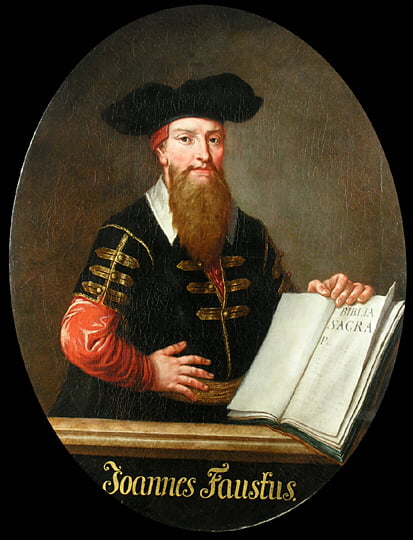
Witchcraft accusations-Johann Fust

[Witchcraft accusations. Johann Fust (c. 1400 – October 30, 1466) was a business partner of Gutenberg, who invented movable type printing, which enabled mass production of books instead of hand-written manuscripts. Fust is sometimes confused with Faust, and has even been nominated as possibly the original Faust by some. Fust took some of Gutenberg’s newly printed bibles and tried to sell them in Paris:]

17th-century German portrait of Johann Fust (c. 1400 – October 30, 1466)  a business partner of Gutenberg.
17th-century German portrait of Johann Fust (c. 1400 – October 30, 1466) a business partner of Gutenberg. displaying a “sacred book,” their printed Bible.

“It was once believed that Johann Fust was working for the devil. After several of Gutenberg’s bibles were sold to King Louis XI of France, it was decided that Fust was performing witchcraft. This idea came about for a few reasons, including the fact that some of the type was printed in red ink, mistaken for blood. It was also discovered that all of the letters in these bibles, presented to the King and his courtiers as hand-copied manuscripts, were oddly identical. Fust had sold 50 bibles in Paris and the people there could not fathom the making and selling of so many bibles so quickly, because printing had not come to the forefront yet in France. Parisians figured that the devil had something to do with the making of these copies, and Fust was thrown into jail on charges of black magic. He was eventually released, since it was proved he was running a business in which printing enabled the rapid production of multiple copies of the same text.”

From <https://en.wikipedia.org/wiki/Johann_Fust>

Cyprianus

Title page in Latin from Cyprianus, 18th century manual of black magic. The title reads: ... key of hell or white and black magic, approved by Metratron.
Title page in Latin from Cyprianus, 18th century manual of black magic. The title reads: … key of hell or white and black magic, approved by Metratron. Credit:Wellcome Library, London.
Cyprianus is also known as the Black Book, and is the textbook of the Black School at Wittenburg, the book from which a witch or sorcerer gets his spells.

The Black School at Wittenburg was purportedly a place in Germany where one went to learn the black arts.

Cyprianus, M. L. , Clavis Inferni sive magia alba et nigra approbata Metratona.
Page 4. Library reference no.: Archives and Manuscripts MS.2000

From Wikipedia:

“The actual stories told of Cyprianus in Scandinavia often made no reference to St. Cyprian. Some made Cyprianus into a typical Faust figure; some said that Cyprianus was a wicked Norwegian or Dane who learned magic through his dealings with the Devil; one version makes Cyprianus so evil that the Devil threw him out of Hell; Cyprianus wrote the text to have his revenge. A different and strongly contradictory version explains that Cyprianus was a student who discovered he was attending a diabolical “black school,” and wrote the text to explain how to undo all the witchcraft he learned there.”
Pasted from <http://en.wikipedia.org/wiki/Cyprianus>

Images relating to witchcraft and potions from the Wellcome Library

[A sample of images relating to witchcraft and potions from the Wellcome Library. The Wellcome Library consists of a large collection of books, manuscripts and images, particularly concentrating on the medicine and the history of medicine. Many of the images are available for public use, and the Library has contributed a large number of images to Wikimedia Commons.

From their website:

“The Library was founded on the collections of Henry Solomon Wellcome (1853-1936).

Born in Almond, Wisconsin, Wellcome became a pharmaceutical salesman and moved to London in 1878 at the encouragement of Silas Burroughs, with whom he entered into partnership to create the firm of Burroughs Wellcome. The business flourished, and Wellcome became sole owner after Burroughs’s death in 1895.

After the death of Burroughs, much of Wellcome’s energy was directed towards developing his collections. His main interest was focused on the history of medicine, including ancillary subjects such as alchemy, witchcraft, anthropology and ethnography.”

The online collection contains thousands of images of historical interest which you can browse to your heart’s content. Here, we provide a few images to whet your appetite:

“Ortus Sanitatis (English: The Garden of Health), also known as the Hortus, is the first natural history encyclopaedia, published by Jacob Meydenbach in Mainz, Germany on 23 June 1491. It describes species in the natural world along with their medicinal uses and modes of preparation. It is in part an extended Latin translation of the German Herbarius published in 1485 but, unlike that earlier work, also deals with animals, birds, fish and stones. The author does not restrict himself to dealing only with real creatures, but also includes accounts of mythical beasts such as the hydra, phoenix, harpy, dragon and zitiron.”

Pasted from <http://en.wikipedia.org/wiki/Ortus_Sanitatis>


L0029212 Credit: Wellcome Library, London
A plant with two children growing out of the buds.
Coloured Woodcut 1491
From: Ortus sanitatis
By: Arnaldus de Villanova,
Published: Jacob MeydenbachMainz 1491
Collection: Rare Books
Library reference no.: Slide number 7658 and EPB Incunabula 5.e.13
Full Bibliographic Record Link to Wellcome Library Catalogue


————–


L0004340 Credit: Wellcome Library, London
A witch placing a scorpion into a pot in order to make a potion. Etching by F. Landerer after M. Schmidt.
By: Martin Joachim Schmidt after: Ferdinand Landerer
Published: s.n.[S.l. :
Collection: Iconographic Collections
Library reference no.: ICV No 26014
Full Bibliographic Record Link to Wellcome Library Catalogue

————–


V0025806ET Credit: Wellcome Library, London
A witch holding a plant in one hand and a fan in the other. Woodcut, ca. 1700-1720.
Woodcut ca. 1700-1720
Size: sheet 9.9 x 8.5 cm.
Collection: Iconographic Collections
Library reference no.: Iconographic Collection 603070i
Full Bibliographic Record Link to Wellcome Library Catalogue


———————–


V0044812 Credit: Wellcome Library, London
A witch, raising her arm above a cauldron, is making a potion; a young woman is kneeling in front of the cauldron; book and skeleton in the background.
1773 By: John Hamilton Mortimer after: Dixon.
Published: J. Boydell & J. Dixon,[London] (Kempes Row Chelsea) : 20 July 1773.
Size: platemark 60.8 x 48.4 cm.
Collection: Iconographic Collections
Library reference no.: Iconographic Collection 576063i
Full Bibliographic Record Link to Wellcome Library Catalogue

Here’s a link to their witchcraft collection, from which many of the above images were taken:

witchcraft collection

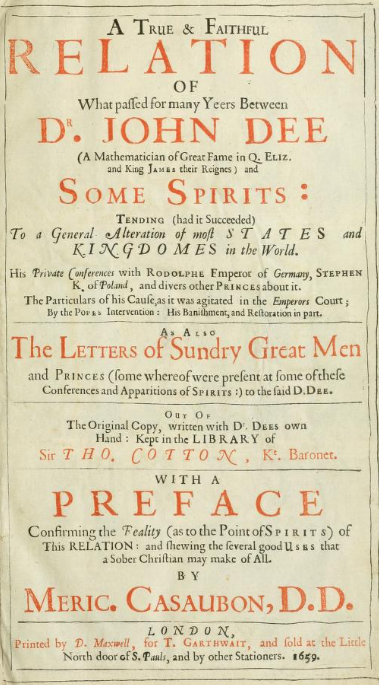
A true & faithful relation of what passed for many yeers

[It was Isaac Casaubon who showed that the Corpus Hermeticum (a collection of influential ancient metaphysical writings believed to from the time of Moses) really only dated from the 2nd and 3rd centuries AD. His son Meric wrote “A true and faithful relation of what passed for many years between Dr. John Dee and Some Spirits” (1659). A true & faithful relation is available at Archive.org:]

See <https://archive.org/details/truefaithfulrela00deej>