John Lambe

Evidence that a reputation for black magic (and rape) could get you killed. John Lambe was an alleged English sorcerer who was murdered by a mob.

From Wikipedia:

“John Lambe (or Lamb) (c. 1545 – 13 June 1628) was an English astrologer who served George Villiers, 1st Duke of Buckingham, during the early 17th century. Accused of black magic and rape, he was stoned to death by an unruly mob in London.”

Pasted from <https://en.wikipedia.org/wiki/John_Lambe>

(Although John Dee was a person of significance in Elizabethan England, he also had a tentative reputation as a sorcerer, and was at times in his life fearful of the consequences and actively fought against libels which could have cost him his life.)

Germany: Magic became associated with the Devil….

Germany: Magic became associated with the Devil. Catholics had “magical” rites. Sensibly, magic being diabolical (according to the Church, it shouldn’t be part of the church, but prayer, blessings, sainthood, and other trappings of the (Catholic) Church were very much magical. Protestants protested (literally) that that wasn’t right.]


The Magician in Medieval German Literature
By Jon B. Sherman

Pasted from <https://books.google.com/books?id=1T6huxN6PxwC&pg=PA102&dq=magician+theodas&hl=en&sa=X&ei=X6HlVMX9OMfsoAT7p4G4Dg&ved=0CC8Q6AEwAA#v=onepage&q=magician%20theodas&f=false>

“…Ideas of the twelfth, thirteenth and fourteenth centuries have also shaped our modern perception of the Devil, as well as the connection between the Devil, demons and magic. This is also the period in which necromancy was officially condemned as heresy. During this foundational time in the understanding of the Devil, demons and sorcery, a number of medieval German narratives strove to anchor the connection between magic and demons—and between magic and heretical and unchristian beliefs—in the figure of the magician. In their treatment of their magicians, Rudolf von Ems’s Barlaam und Josaphat. Wirnt von Grafenberg’s Wigalois and Johann von Wurzburg’s Wilhelm von Osterreich prefigure the developments mentioned above and clearly link magic to the Devil, demons and heresy”

Oops. Oh well. Given the corruption at the highest levels of the Church it was inevitable that people would link the Church and Satan eventually. Yes, Protestants have their magical moments too.

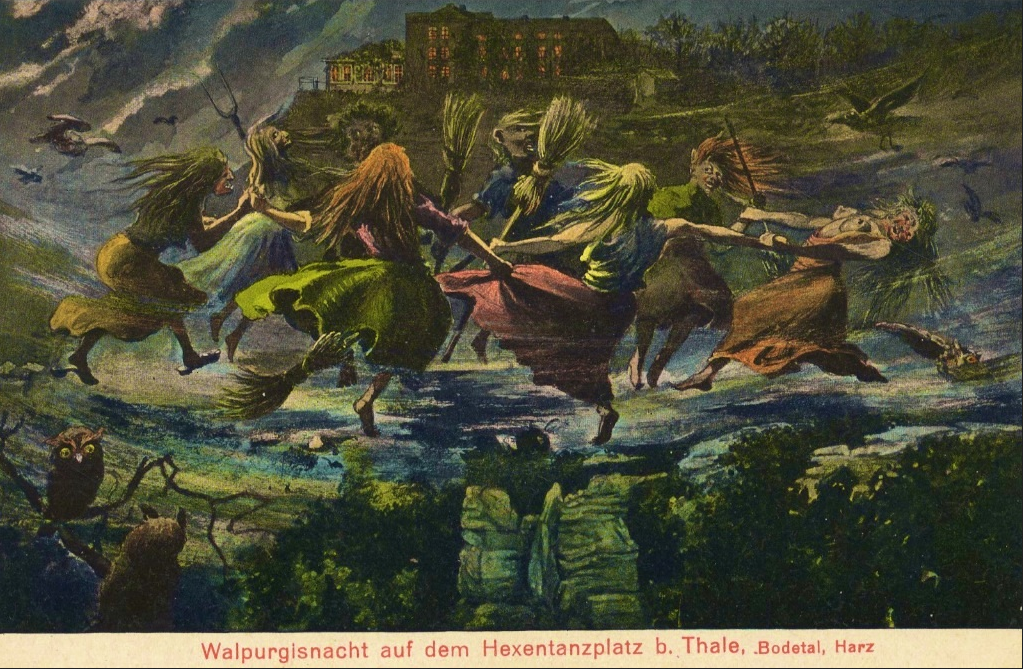
Depictions of witches’ sabbaths in art….

Depictions of witches’ sabbaths in art.


Witches’ Sabbath, 1797-98. Francisco Goya.

Pasted from <http://en.wikipedia.org/wiki/Witches%27_Sabbath_%28Goya,_1798%29>


“Musically, the supposed ritual has been used as inspiration for such works as Night on Bald Mountain by Modest Mussorgsky and the fifth movement of Hector Berlioz’s Symphonie Fantastique.
Depictions in painting include the following:
Witches’ Sabbath by Francisco Goya (1798) Museum of Lázaro Galdiano
Witches’ Sabbath or The Great He-Goat by Francisco Goya (1823) Museo del Prado
Witches’ Flight by Francisco Goya (1798) Museo del Prado
Muse of the Night (Witches’ Sabbath) by Luis Ricardo Falero (1880)
Witches’ Sabbath in Roman Ruins by Jacob van Swanenburgh (1608)
The Vision of Faust by Luis Ricardo Falero (1878)
Witches’ Sabbath by Frans Francken (1606)”

Pasted from <http://en.wikipedia.org/wiki/Witches%27_Sabbath>

Witches’ Sabbath – Woodcut (1510)

Hans Baldung ‘Grien’, Witches’ Sabbath woodcut (1510).

This German woodcut produced in the time of the witch hunts depicts witches tending their brew. Smoke and fumes flow from the pot as one witch lifts the cover. A fifth witch rides a goat backward in the sky.

See https://www.britishmuseum.org/blog/prints-darkness.

Hans Baldung ‘Grien’, Witches’ Sabbath woodcut. 1510.

The Witches’ Sabbath
From Wikipedia, the free encyclopedia:

“There is no agreement among authors concerning the dates on which the Sabbats were to be celebrated. Some hypothosized they would take place during the night of the Sunday before the time the Christian mass was celebrated, some authors disagreed telling that Satan was less powerful on holy days.

Some commonly mentioned dates were February 1 (to some February 2), May 1 (Great Sabbat, Walpurgis Night), August 1 (Lammas), November 1 (Halloween, commencing on October 30’s eve), Easter, and Christmas. Other less frequently mentioned dates were Good Friday, January 1 (day of Jesus’ Crucifixion), June 23 (St. John‘s Day), December 21 (St. Thomas), and Corpus Christi. and others.”

From <http://en.wikipedia.org/wiki/Witches%27_Sabbath>.

Vision of Faust by Luis Ricardo Falero

Faust dreams while Mephistopheles attends him. In his vision beautiful naked women writhe and cavort in the air around him. Mephistopheles sits over him as if in attendance or concentrating on the vision of Faust. Here are aroused and seducing sexual witches, more than just Faust’s fantasy.

Falero was a Spanish painter who relocated to Paris and London. His work was known and popular. His subject matters were often beautiful, naked and nubile young women, his work sometimes on the edge between art and and prurience. Or is it the viewer?

See https://en.wikipedia.org/wiki/Luis_Ricardo_Falero and for a more extensive and revealing bibliography, https://arthistoryproject.com/artists/luis-ricardo-falero/.

Vision of Faust (Faust’s Dream) 1880 painting by Luis Ricardo Falero (1851 – December 7, 1896).

Joannes Faustus (portrait)….

Joannes Faustus (portrait).

17th century German portrait of Faustus. Artist Unknown.

Although often displayed as a portrait of Johann Georg Faust, this is likely a portrait of Johann Fust, a printer from roughly the same area who (a generation of so earlier) was a business partner of Gutenberg. He is holding, not a grimoire, but a copy of their printed Vulgate Bible (Biblia Sacra Latina (1462)). Of course Gutenberg is now known for inventing mass production of books, but Fust (or Faustus) as salesman was charged with witchcraft in France for having more virtually identical Bibles in his possession than a man could produce in a lifetime. Once the nature of the invention was explained, he was released.