
What’s a Pact? What’s a Wager?Pact:An agreement or compact between two or more parties, nations, etc, for mutual advantagePasted from <http://dictionary.reference.com/browse/pact> Wager:Something risked or staked on an uncertain eventPasted from <http://dictionary.reference.com/browse/wager+>
We have lost our ability to see the night sky
“The night sky and studies of it have a historical place in both ancient and modern cultures. In the past, for instance, farmers have used the state of the night sky as a calendar to determine when to plant crops. Many cultures have drawn constellations between stars in the sky, using them in association with legends and mythology about their deities.
The anciently developed belief of astrology is generally based on the belief that relationships between heavenly bodies influence or convey information about events on Earth. The scientific study of the night sky and bodies observed within it, meanwhile, takes place in the science of astronomy.
The visibility of celestial objects in the night sky is affected by light pollution. The presence of the Moon in the night sky has historically hindered astronomical observation by increasing the amount of ambient lighting. With the advent of artificial light sources, however, light pollution has been a growing problem for viewing the night sky.”
Pasted from <https://en.wikipedia.org/wiki/Night_sky>
Is it simple irony that we, the Faustian Civilization, have lost our view of God? Or are we deceived?
Until less than a few hundred years ago – a blip in the history of humans (a half-million years) – every person could – probably did – look up into the sky at night and have his own intimate relationship with God. The stars drew upward, and inspired awe, fear, and worship. It was easy to imagine that the stars dominated our lives in some way.
Our ancestors lived with the night sky. They found their gods up there, and small wonder because there is nothing as awe-inspiring as the sight of the Milky Way on a moon-less night.
But most of us never see it. This is a new development in the history of humanity that we give little thought to. We don’t see it, are never astonished, and never experience that direct connection with God.
Our ability to connect with and know our gods has been cut off: electric lights, indoor city living, ambient light pollution, TV, computers and the eight-hour work day have separated individuals from the stars – the root of religion. This has happened in less than two hundred years.
We have no personal sight of God. Humans are directed to turn to others to discover their intimate relationship with God. Our personal contact with God is replaced by images that tell us how to believe and how to act. People of Faust’s time were already questioning their priests. It is ironic that the movement that returned Christianity to the people, spawned the industrial boom that shut out God. Perhaps it’s not ironic at all, for the same movement removed the magic.
…And then they took away the sky. We no longer know the stars as our ancestors did – an intimate part not just of human life, but of life itself.
We are incapable of that personal experience of God. The cathedral is rendered invisible by light – and the worshippers have forgotten they are in it. The routine experience of agape is gone.
What does it mean when our direct connection to God is cut off? Men are being diverted, enclosed, put to sleep slowly, over generations, and they forget their connection to the sky, the nightly enchantment: their transport. Their wildness is gone. They forget they had no masters. Is this our Faustian bargain: our technology blocking us from the sight of God – our prison walls? Is this Hell, and are we locked in it – we who have never seen the face of God or tasted the eternal joy of heaven?
Edward Kelley, a Magician in the Act of invoking the Spirit of a Deceased Person
Edward Kelley, a Magician in the Act of invoking the Spirit of a Deceased Person (an 1806 artist’s impression):
“Edw[ar]d Kelly, a Magician. in the Act of invoking the Spirit of a Deceased Person.Astrology, A New and Complete Illustration of the Occult Sciences by Ebenezer Sibly, M.D. F.R.H.S., Embellished with Curious Copper-Plates, London, 1806Pasted from <https://commons.wikimedia.org/wiki/File:A_Magician_by_Edward_Kelly.jpg>
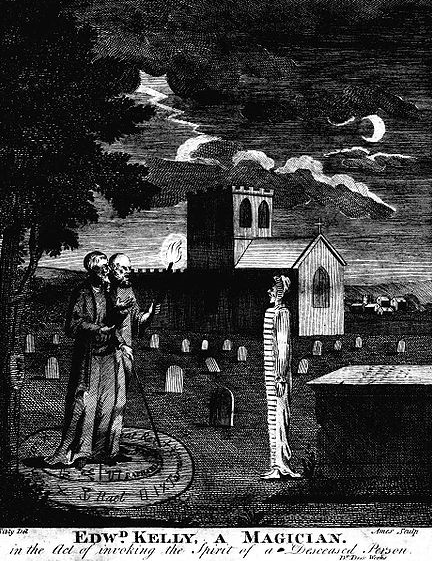
[There’s a better copy of the illustration below.]
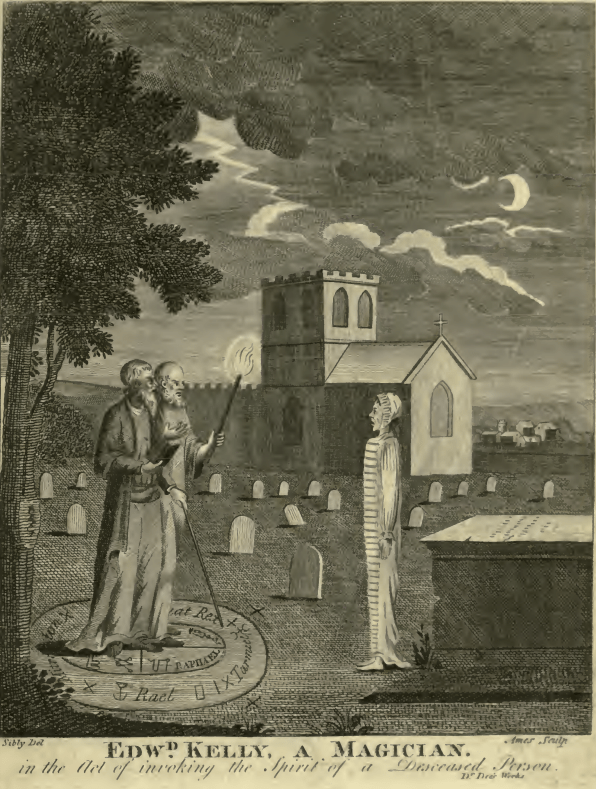
[Here’s some text on Kelly/Kelley from Sibly’s 1826 A new and complete illustration of the celestial science of astrology…. It’s a different edition of the same book. Note that this is over 200 years old, and can’t be relied upon for historical truth. The above illustration is about 7 pages after, and shows Kelley and his partner in the churchyard. Note also the Faustian ending described! We begin with Sibly’s short biography of John Dee:]
Doctor Dee was another very extraordinary character of the same class [having just described Appollonius Tayaneus, from the time of the Emperor Domitian], and a native of this island. He was not only a famous magician, but a great author, having written upwards of forty-eight different volumes, the first of which was published in 1594. A full account of his conversation and intercourse with spirits is now extant, written with his own hand, and esteemed a very curious and singular performance. His company and acquaintance was much sought by the Emperor Charles V. and by Ferdinand his brother; and, during his travels over the continent, he had not only every respect and attention paid him, but his company was courted by all the learned and religious people wherever he went. He was certainly one of the most learned men of the age in which he lived, and had collected a library of upwards of 4,000 volumes of curious and valuable writings, mostly upon physical, theological, and occult subjects, which he had the misfortune to see burnt by the fury of a mob, who assailed his house, and conspired against his life, under an idea that by magical spells and incantations he had altered the natural course of the weather, and brought on storms, hurricanes, tempests, and, continual rain, in order to ruin the harvest, and destroy the fruits of the earth. Yet he bore the torrent and fury of this infatuated, multitude with the greatest composure, saying, “They would see their error soon enough to treat him with greater kindness hereafter than their persecution was now cruel.” And so it happened; for, having by means of his confederacy with spirits foretold and detected a fatal conspiracy against his country, he was then as much honoured and caressed as he had before been stigmatized and abused by the hasty multitude. He wrote the mathematical preface to Euclid’s Elements, and has left tables of the harmony and extent of numbers infinitely beyond the capacity of the present times, though so much more learned and refined.
Edward Kelly was also a famous magician, and the companion and associate of Dr. Dee, in most of his magical operations and exploits; having been brought in union with him (as the Doctor himself declares, in preface to his work upon the initiation of spirits) by mediation of angel Uriel. But Dr. Dee was undoubtedly deceived in his opinion, that the spirits which ministered to him were executing the Divine will, and were the messengers and servants of the Deity. Throughout writings on the subject, he evidently considers them in this light, which is still more indisputably confirmed by the piety and devotion invariably observed at all times when these spirits had intercourse with him. And further, when he found his coadjutor Kelly was degenerating into the lowest and worst species of the magic art, for the purposes of fraud and avaricious gain, he broke off all manner of connection with him. and would never after be seen in his company. But it is believed, that the Doctor, a little before his death, became sensible that he had been imposed upon by these invisible agents, and that all their pretences of acting under the auspices of the angel Uriel, and for the honour and glory of God, were but mere hypocrisy, and the delusions of the devil. Kelly, being thus rejected and discountenanced by the doctor, betook himself to the meanest and most vile practices of the magic art; in all which pursuits money, and the works of the devil, appear to have been his chief aim. Many wicked and abominable transactions are recorded of him, which were performed by witchcraft, and the mediation of infernal spirits ; but nothing more curious, or more apropos to the present subject, than what is mentioned by Weaver, in his Funeral Monuments. He there records, that Edward Kelly the magician, with one Paul Waring, who acted in capacity of companion and associate in all his conjurations, went together to the church-yard of Walton Ledale, in the county of Lancaster, where they had information of a person being interred, who was supposed to have hidden or buried a considerable sum of money, and, to have died without disclosing to any person where it was deposited. They entered the church-yard exactly at twelve o’clock at night; and, having had the grave pointed out to them the preceding day, they exorcised the spirit of the deceased by magical spells and incantations, till it appeared before them, and not only satisfied their wicked desires and enquiries, but delivered several strange predictions concerning persons in that neighbourhood, which were literally and exactly fulfilled. It was vulgarly reported of Kelly, that he outlived the time of his compact with the devil, and was seized at midnight by some infernal spirits, who carried him off in fight of his own wife and children, at the instant he was meditating a mischievous scheme against the minister of his parish, with whom he was greatly at enmity. (Page 1099)
A new and complete illustration of the celestial science of astrology: or, The art of foretelling future events and contingencies by the aspects, positions, and influences of the heavenly bodies … In four parts. by Sibly, Ebenezer, 1751-1800. See it at https://archive.org/details/newcompleteillus00sibluoft
Here’s the same illustration from the 1826 edition. It’s better quality.
The Fortunes of Faust….
The Fortunes of Faust.From the web page:Historian Jeffrey Burton Russel writes:“The Faustbook tells how Faustus, abandoning Philosophy, turns to magic. Given the antischolastic bias of the Protestant Reformation, it was natural that the Faustbook should make the figure of the man who sells his soul to Satan a scholar: Faust desires to obtain knowledge by his own efforts rather than receive it by grace. This individualistic rebellion ties Faust’s sin to the original sin of humanity (Adam and Eve’s theft of the forbidden fruit of the tree of knowledge) and to pride (the original sin of Lucifer himself)…In order to master magical lore, Faustus determines to call up the Devil. Going to the crossroads at night, he inscribes magical circles and characters upon the ground and invokes a spirit (Gaist) by the name of Beelzebub. Here the author deliberately mixes magic and witchcraft, the traditional signs and symbols of hermetic magic with the witch-like invocation of an evil spirit.”– Mephistopheles: The Devil in the Modern Age (P. 60-61; italics mine)The spirit which appears first takes the form of a dragon, then turns into a fiery globe, and finally into a greyfriar. It gives it’s name to Faust as “Mephistophiles,” a combination of Greek, Latin, and possibly even Hebrew elements. Russel breaks the name down as such: “Greek mē, “not”; phōs, photos, “light”; and philos, “lover” – yielding “he who is not a lover of the light,” an ironic parody of Lucifer, light-bearer.”by Jack Faust.Pasted from <http://vonfaustus.blogspot.ca/2010/06/fortunes-of-faust.html>
If I…
If I, Martin Luther, had given him even my hand, he would have destroyed me.

Martin Luther portrait by Hans Holbein the YoungerFROM THE TISCHREDEN OF MARTIN LUTHER. ‘Mention was made of magicians and the magic art, and how Satan blinded men. Much was said about Faust, who called the devil his brother-in-law, and the remark was made: “If I, Martin Luther, had given him even my hand, he would have destroyed me; but I would not have been afraid of him,—with God as my protector, I would have given him my hand in the name of the Lord.” ‘Sources of the Faust Tradition By Philip M. Palmer, Robert P. More, Robert T. Morebooks.google.com/books?id=89UA_SzzaEMC&lpg=PA93&pg=PA93#v=onepage&q&f=false
YouTube Video – Faust 1926 – The Evocation of Mephisto
YouTube Video – Faust 1926 – The Evocation of MephistoPasted from <http://www.youtube.com/watch?v=7TCfNFckx6Q&feature=related>
YouTube Video – Svankmajer’s Faust 1994 – Faustus summons Mephistophilis
YouTube Video – Svankmajer’s Faust 1994 – Faustus summons Mephistophilis.
from Svankmajer’s 1994 film
Youtube Video
Youtube VideoFAUSTUS – Seven Deadly SinsDR. FAUSTUS by Christopher MarloweProcession of the Seven Deadly Sins (Lechery, Sloth, Envy, Covetousness, Gluttony, Pride, Wrath)from Doctor FaustusPasted from <http://www.youtube.com/watch?v=ZoNcrW8gl-0&feature=related>
Grimoires:
[The historical presence of Faust and the development of his legend from Owen Davies’ Grimoires: a history of magic books:]

By Owen Davies
p50.
Grimoires:
[The early formation of the developing Faust legend into the original Faust book or Faustbuch from Owen Davies’ Grimoires: a history of magic books. Below – the influential woodcut from the 1553 book The Devil of Magic (Der Zauber Teuffel).]

By Owen Davies P.50.
Re: Devil of Magic: The above referenced woodcut is:

