A Swabian Cobbler-Farmer Survives the Thirty Years War – Hans

In the area of Central Europe, including Germany, the Thirty Years War (between 1618 and 1648) was a brutal conflict over Protestant-Catholic religious and political differences. The number who died in that long war, from all manner of consequences, including famine and the plague, numbered in the millions. The historical Faust, whose fictional legend was popular about 1580, but who had died around 1541 was possibly born within Württemberg.

According to Wikipedia:

“So great was the devastation brought about by the war that estimates put the reduction of population in the German states at about 25 to 40 percent. Some regions were affected much more than others. For example, Württemberg lost three-quarters of its population during the war. In the territory of Brandenburg, the losses had amounted to half, while in some areas an estimated two-thirds of the population died. The male population of the German states was reduced by almost half. The population of the Czech lands declined by a third due to war, disease, famine and the expulsion of Protestant Czechs. Much of the destruction of civilian lives and property was caused by the cruelty and greed of mercenary soldiers. Villages were especially easy prey to the marauding armies. Those that survived, like the small village of Drais near Mainz, would take almost a hundred years to recover. The Swedish armies alone may have destroyed up to 2,000 castles, 18,000 villages and 1,500 towns in Germany, one-third of all German towns.”

https://en.wikipedia.org/wiki/Thirty_Years%27_War

From Germanhistorydocs:

A Swabian Cobbler-Farmer Survives the Thirty Years War – Hans Heberle (1597-1677):

The Great Comet and the Start of the War (1618 and 1619)

“In 1618 a great comet appeared in the form of great and terrible rod, which was accorded us by and through God because of our sinful lives, which we have richly earned in the past and continue to earn daily. “

Pasted from <http://germanhistorydocs.ghi-dc.org/sub_document.cfm?document_id=3709>

“On August 25 [1628], between one and two o’clock in the afternoon, my dear wife brought into this world for me my daughter Catherine, her first child, who was baptized that very evening during the preaching service. On that day, the sun rose at about 5:22 in the morning, and the moon stood in the sign of Scorpio.”

Pasted from <http://germanhistorydocs.ghi-dc.org/docpage.cfm?docpage_id=4404>

German History in Documents and Images (GHDI) is a comprehensive collection of primary source materials documenting Germany’s political, social, and cultural history from 1500 to the present.

Pasted from <http://germanhistorydocs.ghi-dc.org/index.cfm>

[An interesting web site, well worth pursuing]
The study of nature was pursued more for practical reasons

The study of nature, including observations of the sky, though not a higher calling, was important for practical reasons.

“The study of nature was pursued more for practical reasons than as an abstract inquiry: the need to care for the sick led to the study of medicine and of ancient texts on drugs, the need for monks to determine the proper time to pray led them to study the motion of the stars, the need to compute the date of Easter led them to study and teach rudimentary mathematics and the motions of the Sun and Moon.

Pasted from <http://en.wikipedia.org/wiki/Science_in_the_Middle_Ages>”

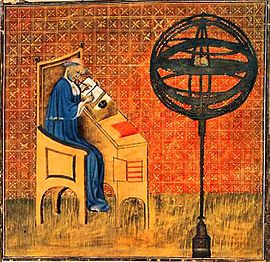
Portrait of Nicole Oresme, Thinker

Portrait of Nicole Oresme: Miniature from Oresme’s Traité de l’espere, Bibliothèque Nationale, Paris, France, fonds français 565, fol. 1r.


Pasted from <http://en.wikipedia.org/wiki/Oresme>

“Nicole Oresme c. 1320–1325 – July 11, 1382) was a significant philosopher of the later Middle Ages. He wrote influential works on economics, mathematics, physics, astrology and astronomy, philosophy, and theology; was Bishop of Lisieux, a translator, a counselor of King Charles V of France, and probably one of the most original thinkers of the 14th century.”
Pasted from <https://en.wikipedia.org/wiki/Nicole_Oresme>

From the Rubáiyát of Omar Khayyám

From the Rubáiyát of Omar Khayyám

Myself when young did eagerly frequent
Doctor and Saint, and heard great Argument
About it and about: but evermore
Came out of the same Door as in I went.

With them the Seed of Wisdom did I sow,
And with my own hand labour’d it to grow:
And this was all the Harvest that I reap’d –
“I came like Water, and like Wind I go.”

Into this Universe, and why not knowing,
Nor whence, like Water willy-nilly flowing:
And out of it, as Wind along the Waste,
I know not whither, willy-nilly blowing.

And that inverted Bowl we call The Sky,
Whereunder crawling coop’t we live and die,
Lift not thy hands to It for help – for It
Rolls impotently on as Thou or I.


Pasted from <http://en.wikipedia.org/wiki/Omar_Khayy%C3%A1m>

A discussion of the place of the Acacia in Freemasonry….

[A discussion of the place of the Acacia in Freemasonry. Acacia is mentioned in the Bible and attracts attention because some species contain the so-called “spirit molecule,” DMT. Of all psychoactive drugs, DMT can provide most convincing religious experiences, including experiences of God. Is it mere coincidence that links religion and DMT?

Acacia is not a single type of plant. It’s a genus name and there are a number of Acacia plants in the world (not all of which contain DMT, and others are contested) and there are other sources of DMT, many of which are important religious sacraments for their psychoactive properties outside of Christianity.]

From Wikipedia on Acacia (this information had been removed by Oct 2016. The Acacia genus has been re-arranged):

Symbolism and ritual

The Acacia is used as a symbol in Freemasonry, to represent purity and endurance of the soul, and as funerary symbolism signifying resurrection and immortality. The tree gains its importance from the description of the burial of Hiram Abiff, the builder of King Solomon’s Temple in Jerusalem.

Several parts (mainly bark, root and resin) of Acacia are used to make incense for rituals. Acacia is used in incense mainly in India, Nepal, and China including in its Tibet region. Smoke from Acacia bark is thought to keep demons and ghosts away and to put the gods in a good mood. Roots and resin from Acacia are combined with rhododendron, acorus, cytisus, salvia and some other components of incense. Both people and elephants like an alcoholic beverage made from acacia fruit. According to Easton’s Bible Dictionary, the Acacia tree may be the “burning bush” (Exodus 3:2) which Moses encountered in the desert. Also, when God gave Moses the instructions for building the Tabernacle, he said to “make an ark ” and “a table of acacia wood” (Exodus 25:10 & 23, Revised Standard Version).

Pasted from <http://en.wikipedia.org/wiki/Acacia>

Alkaloids

As mentioned previously, Acacias contain a number of organic compounds that defend them from pests and grazing animals. Many of these compounds are psychoactive in humans. The alkaloids found in Acacias include dimethyltryptamine (DMT), 5-methoxy-dimethyltryptamine (5-MeO-DMT) and N-methyltryptamine (NMT). The plant leaves, stems and/or roots are sometimes made into a brew together with some MAOI-containing plant and consumed orally for healing, ceremonial or religious uses. Egyptian mythology has associated the acacia tree with characteristics of the tree of life (see the article on the Myth of Osiris and Isis).

Pasted from <http://en.wikipedia.org/wiki/Acacia>

Go down, sit in the dust, Virgin Daughter Babylon.

Isaiah 47 (New International Version (NIV))
The Fall of Babylon

God/Isaiah is is speaking to the Babylonians who captured the Jews and forced them into exile for sixty years (The Babylonian Captivity from 597-539BCE). Soon Cyrus will come to save them. But in a sense, it will be too late. The Babylonians took the elite of Israel into their own city as hostages, to be used and to be assimilated. When they returned to Jerusalem, they returned with adopted myths and magic. Christianity contains elements of the the Babylonian culture and of other cultures which passed through the Middle East – the Jews, of course, the Egyptians, and the Greeks among others (though degree and direction of influences are debated). The occult arts of the region of the Babylonians were highly regarded and influential in Europe in later centuries.

“(5.) Sit in silence, go into darkness,
queen city of the Babylonians;
no more will you be called
queen of kingdoms.

I was angry with my people
and desecrated my inheritance;
I gave them into your hand,
and you showed them no mercy.

Even on the aged
you laid a very heavy yoke.

You said, ‘I am forever—
the eternal queen!’
But you did not consider these things
or reflect on what might happen.

“(12.) Keep on, then, with your magic spells
and with your many sorceries,
which you have labored at since childhood.

Perhaps you will succeed,
perhaps you will cause terror.

All the counsel you have received has only worn you out!
Let your astrologers come forward,

those stargazers who make predictions month by month,
let them save you from what is coming upon you.

Surely they are like stubble;
the fire will burn them up.

They cannot even save themselves
from the power of the flame.

These are not coals for warmth;
this is not a fire to sit by.

That is all they are to you—
these you have dealt with
and labored with since childhood.

All of them go on in their error;
there is not one that can save you. “

Pasted from <http://www.biblegateway.com/passage/?search=Isaiah+47&version=NIV>

What is my disease?

From “The Casebooks Project

The website provides access to the case history books of two of England’s most active and prominent professional astrologers of the late 16th/early seventeenth century, beginning three years after the death of Marlowe:

“What is my disease? Am I pregnant? Will I die? These are the sorts of questions that thousands of people asked Simon Forman and Richard Napier, two of the most popular astrologers in early modern England. Through four busy decades, Forman and Napier recorded more than 50,000 consultations. Their casebooks are probably the richest surviving records of medical practice before 1700. They provide a unique view of the lives of ordinary — and extraordinary — people four centuries ago. Our freely available electronic edition will combine sophisticated editorial expertise and cutting-edge digital humanities to make these records accessible as never before.”


See <https://casebooks.lib.cam.ac.uk/>


Simon Forman in http://books.google.com/books?id=S7U_AAAAcAAJ&dq=Simon William Lilly’s history of his life and times from the year 1602 to 1681, by William Lilly.

(Astrology in those times

Spenglerian terms

Oswald Spengler (1880 – 1936) was a German philosopher of history. He said that a civilization was the end-state of culture, and wouldn’t last. He characterized Western civilization as Faustian:

From Wikipedia:

According to Spengler, the Western world is ending and we are witnessing the last last season—”winter time”—of the Faustian Civilization. In Spengler’s depiction, Western Man is a proud but tragic figure because, while he strives and creates, he secretly knows the actual goal will never be reached.

Pasted from <https://en.wikipedia.org/wiki/The_Decline_of_the_West>

Spengler outlines different civilisations, with the Western one being Faustian. Both Faust and Western civilization are influenced by Magian and Apollonian civilizations – the latter especially so in the eighteenth century time of Goethe and his Faust, since the rediscovery of Greek literature which helped lead Europe from the Church to a secular, humanist society.

Spengler invests certain terms with unusual meanings not commonly encountered in everyday discourse.

Apollonian / Magian / Faustian These are Spengler’s terms for Classical, Arabian and Western civilisations respectively.

Apollonian Civilisation is focused around Ancient Greece and Rome. Spengler saw its world view as being characterised by appreciation for the beauty of the human body, and a preference for the local and the present moment.

Magian Civilisation includes the Jews from about 400BC, early Christians and various Arabian religions up to and including Islam. Its world feeling revolved around the concept of world as cavern, epitomised by the domed Mosque, and a preoccupation with essence. Spengler saw the development of this civilisation as being distorted by too influential presence of older cultures, the initial vigorous expansionary impulses of Islam being in part a reaction against this.

Faustian Civilisation began in Western Europe around the 10th century and according to Spengler such has been its expansionary power that by the 20th century it was covering the entire earth, with only a few Regions where Islam provides an alternative world view. The world feeling of Faustian civilisation is inspired by the concept of infinitely wide and profound space, the yearning towards distance and infinity.

Pasted from <http://en.wikipedia.org/wiki/The_Decline_of_the_West>

From The Decline of the West, Spengler on Goethe:

“Plato and Goethe stand for the philosophy of Becoming, Aristotle and Kant the philosophy of Being… Goethe’s notes and verse… must be regarded as the expression of a perfectly definite metaphysical doctrine. I would not have a single word changed of this: “The Godhead is effective in the living and not in the dead, in the becoming and the changing, not in the become and the set-fast; and therefore, similarly, the reason is concerned only to strive towards the divine through the becoming and the living, and the understanding only to make use of the become and the set-fast.(Letter to Eckermann)” This sentence comprises my entire philosophy.”

Pasted from <http://en.wikipedia.org/wiki/The_Decline_of_the_West>