As Christianity grew in influence…

[An herbalist (for example) might recite a short prayer before collecting a plant. Before Christianity, his/her ancestors would have used a traditional folk invocation. After Christianity, the herbalist would replace the old formulae with something more suitable and more powerful (since Chrstianity was the “true” faith, and the old ways, while good, were fatally misguided).

By “Christianizing” old spells and rituals and incantations, people expressed their Christian faith, but at the same time maintained and protected the old ways—and themselves. Old way=evil. New way=good. However genuine your faith, you didn’t want to attract the wrong kind of attention from the Church. The Church, for its part, made ingratiating inroads in the other direction, consenting to consecrations of grounds and buildings, blessings of animals and property, and allowing the continuation of the old holy days and sacred grounds, with a new Christian understanding.]

“As Christianity grew in influence, a tension developed under the church and folk-medicine, since much in folk medicine was magical, or mystical, and had its foundation in pagan sources that were not compatible with Christian faith. Spells and incantations were used in conjunction with herbs and other remedies. Such spells had to be separated from the physical remedies, or replaced with Christian prayers or devotions. Similarly, the dependence upon the power of herbs or gems needed to be explained through Christianity.”

Pasted from <http://en.wikipedia.org/wiki/Medieval_medicine>

[We’d like to say that in the end the solution was to separate the spells from the physical remedies, but we’ve learned we can’t just rely on chemicals to heal us. In healing, set and setting are also important. Spells and incantations were part of a ritual which formalized (and standardized) the healer’s routine and manipulated the patient’s mental state toward good health.]

Luther on Copernicus

Martin Luther (leader of the Protestant Reformation in Germany and contemporary of the real Faust) on Copernicus who unwisely showed how the Earth went around the sun and not the other way around as the Bible said:

“People gave ear to an upstart astrologer who strove to show that the earth revolves, not the heavens or the firmament, the sun and the moon….This fool wishes to reverse the entire science of astronomy; but sacred scripture tells us [Joshua 10:13]that Joshua commanded the sun to stand still, and not the earth.”

[Martin Luther in one of his “Table Talks” in 1539]

Also:

“People give ear to an upstart astrologer [Copernicus]who strove to show that the earth revolves, not the heavens or the firmament, the sun and the moon. Whoever wishes to appear clever must devise some new system, which of all systems is of course the very best. This fool wishes to reverse the entire science of astronomy.”

[Martin Luther, Works, Volume 22, c. 1543]

Pasted from <http://articles.exchristian.net/2002/04/martin-luther-quotes.php>

Although his work was known in circles, Copernicus wisely held off publication until near his death in 1543.

Luther’s friend and colleague, Philip Melanchthon (who also knew of Faust), said this in 1549:

“The eyes are witnesses that the heavens revolve in the space of twenty-four hours. But certain men, either from the love of novelty, or to make a display of ingenuity, have concluded that the earth moves; and they maintain that neither the eighth sphere [the celestial sphere] nor the sun revolves. … Now, it is a want of honesty and decency to assert such notions publicly, and the example is pernicious. It is the part of a good mind to accept the truth as revealed by God and to acquiesce in it.”

What I have done is to show that it is

Quotes from modern-day scientists:

“What I have done is to show that it is possible for the way the universe began to be determined by the laws of science. In that case, it would not be necessary to appeal to God to decide on how the universe began. This doesn’t prove that there is no God, only that God is not necessary.”
-Stephen W. Hawking (Der Spiegel, 1989)

“The most important scientific revolutions all include, as their only common feature, the dethronement of human arrogance from one pedestal after another of previous convictions about our centrality in the cosmos.”
-Stephen Jay Gould (Dinosaur in a Haystack)

Pasted from <http://www.nobeliefs.com/great-quotes.htm>

The truth is that Christian theology….

“The truth is that Christian theology, like every other theology, is not only opposed to the scientific spirit; it is also opposed to all other attempts at rational thinking. Not by accident does Genesis 3 make the father of knowledge a serpent — slimy, sneaking and abominable. Since the earliest days the church as an organization has thrown itself violently against every effort to liberate the body and mind of man. It has been, at all times and everywhere, the habitual and incorrigible defender of bad governments, bad laws, bad social theories, bad institutions. It was, for centuries, an apologist for slavery, as it was the apologist for the divine right of kings.”

H. L. Mencken

“To command the professors of astronomy to confute their own observations is to enjoin an impossibility, for it is to command them to not see what they do see, and not to understand what they do understand, and to find what they do not discover.”
Galileo Galilei, The Authority of Scripture in Philosophical Controversies

As a bonus, here’s a quote attributed to Ferdinand Magellan which is falsely attributed. He DIDN’T say this, and it seems out of character anyway:

“The church says the earth is flat, but I know that it is round, for I have seen the shadow on the moon, and I have more faith in a shadow than in the church.”

NOT by Ferdinand Magellan. Incorrectly attributed to him by Robert Green Ingersoll in his essay “Individuality” (1873)

The Church reacts to the observations of early astronomy (seventeenth

The Church reacts to the observations of early astronomy (seventeenth century Galileo Inquisition):

“The first proposition, that the sun is the center and does not revolve about the earth, is foolish, absurd, false in theology, and heretical, because contrary to Holy Scripture…the second proposition, that the earth is not the center but revolves about the sun, is absurd, false in philosophy, and, from a theological point of view at least, opposed to the true faith.” — 1615 Galileo Inquisition pronouncement.

“The opinion of the earth’s motion is of all heresies the most abominable, the most pernicious, the most scandalous; the immovability of the earth is thrice sacred; argument against the immortality of the soul, the existence of God, and the incarnation, should be tolerated sooner than the argument to prove that the earth moves.” — Jesuit Father Melchior Inchofer (1631).

“Animals, which move, have limbs and muscles; the earth has no limbs or muscles, therefore it does not move.

It is angels who make Saturn, Jupiter, the Sun, etc., turn around. If the earth revolves, it must have an angel in the centre to set it in motion; but only devils live there; it would therefore be a devil who would impart motion to the earth.

The planets, the sun, the fixed stars, all belong to one species-namely that of stars – they therefore all move or all stand still. It seems, therefore, to be a grievous wrong to place the earth, which is a sink of impurity, among these heavenly bodies, which are pure and divine things.” — Scipio Chiariamonti, associate of Cardinal Barberini.

Alchemy in the Western World and other locations where it

Western astrology contains elements of alchemy.

Alchemy in the Western World and other locations where it was widely practiced was (and in many cases still is) allied and intertwined with traditional Babylonian-Greek style astrology; in numerous ways they were built to complement each other in the search for hidden knowledge (knowledge that is not common i.e. the occult). Astrology has used the concept of classical elements from antiquity up until the present day today. Most modern astrologers use the four classical elements [earth, water, air, and fire] extensively, and indeed it is still viewed as a critical part of interpreting the astrological chart.

Traditionally, each of the seven “planets” in the solar system as known to the ancients was associated with, held dominion over, and “ruled” a certain metal (see also astrology and the classical elements).

The list of rulership is as follows:

  • The Sun rules Gold
  • The Moon, Silver
  • Mercury, Quicksilver/Mercury
  • Venus, Copper
  • Mars, Iron
  • Jupiter, Tin
  • Saturn, Lead

Pasted from <http://en.wikipedia.org/wiki/Classical_planets_in_Western_alchemy>

After almost a century of steady decline…

“After almost a century of steady decline, the years from 1780 onwards witnessed the faint beginnings of a revival of astrology, for reasons which are not easy to explain. Was this revival connected in some way with Romanticism, with the cult of nature or of the past? The evidence is very slight; Goethe is probably the only serious European writer of this period to mention astrology, giving some details of his own horoscope in the course of his autobiography, yet it plays no part in his dramas, even where we might expect it, in Faust. “

P 191. Astrology: a history. By Peter Whitfield. Abrams, 2001

Zaubereÿ – Sorcery….

Zaubereÿ – Sorcery. Etching, Nuremberg 1626

“Matthäus Merian der Ältere (or “Matthew”, “the Elder”, or “Sr.”; 22 September 1593 – 19 June 1650) was a Swiss-born engraver who worked in Frankfurt for most of his career, where he also ran a publishing house.”

Pasted from <http://en.wikipedia.org/wiki/Matth%C3%A4us_Merian>

Following is his engraving of a witches’ dance.

Also a full res size:
http://commons.wikimedia.org/wiki/File:Zauberey_1626.jpg


Hanseatic League dominated Northern Europe sea trade about 1350

Hanseatic League dominated Northern Europe sea trade about 1350 – 1490.

The period of time that the Hanseatic League dominated the sea trade in Northern Europe was very short—only about 100 years from about 1350 until about 1490.[4] However, during that time the Hanseatic League had the effect of bringing an early “Renaissance” to northern Europe and in particular to northern Germany.


Pasted from <http://en.wikipedia.org/wiki/German_peasants_war_of_1524-1525>


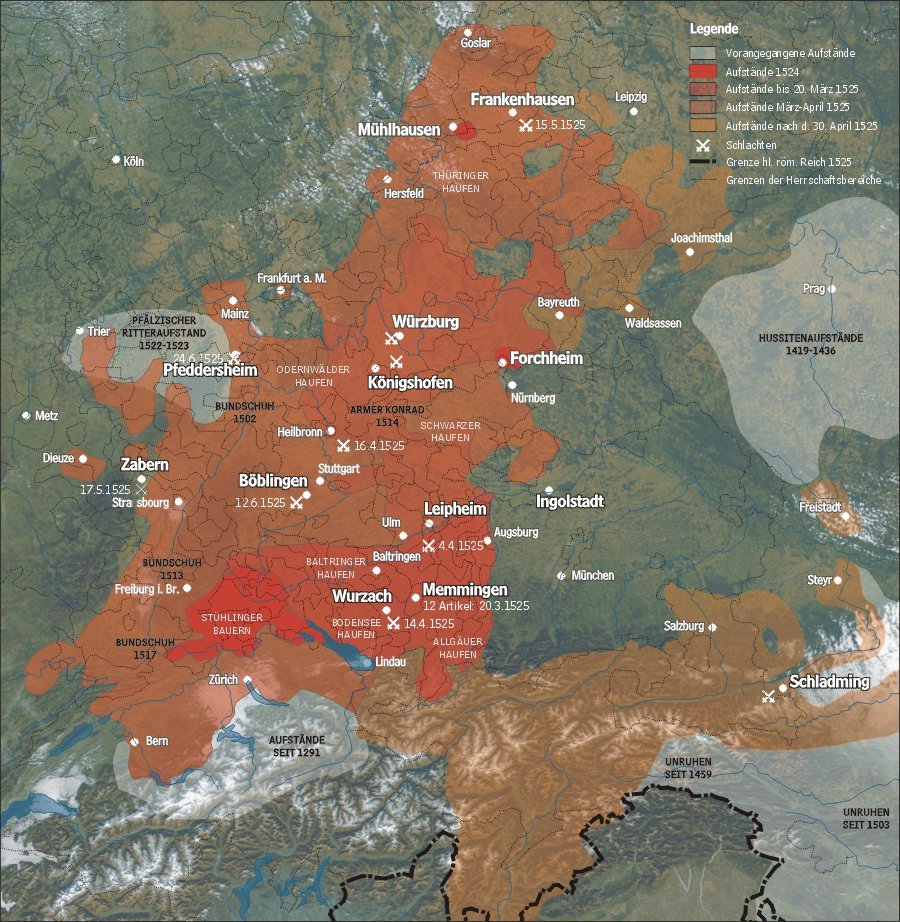
The Revolution of 1525

The Revolution of 1525

Peasants rebellion was most severe in areas including Erfurt, Wurttemberg, etc. These are areas closely associated with the real Faust (living approx. 1480 – 1540).

“…the German Peasants’ War, the largest insurrection in European history before the French Revolution.”

Psychologically, the revolution was a major event in the early Protestant Reformation: it strengthened the convictions of some that religious abuses formed the main reasons for rebellion; it bolstered the arguments of others that the new doctrines had caused the revolution. “

Pasted from <http://germanhistorydocs.ghi-dc.org/map.cfm?map_id=3667>

See this same site for multiple interesting articles: (The Grievances of Rural Subjects – Kempten (Upper Swabia) (1492), Cannibalism at Breisach (1638) , The Terrible Year (1635) and the Peace of Prague ) for descriptions of life.

Map:


http://upload.wikimedia.org/wikipedia/commons/8/82/Karte_bauernkrieg3.jpg

See: http://en.wikipedia.org/wiki/German_Peasants%27_War