[What happened to Dee? What happened to Marlowe? Knowledge has been lost over the centuries, but … where are the bodies? Their absence keeps conspiracy theories alive. We have not seen evidence that Dee did anything but die. Same with Marlowe. Neither have we seen evidence that Dee was consulted about the Spanish, and as noted, he was far away at the time.]
John Dee lived on the south bank of the Thames…
[John Dee lived on the south bank of the Thames, a few hours up by barge from London, but was even closer to Richmond Palace where the Queen spent a lot of time. Consequently visitors would drop in for consultations and demonstrations, or to examine his collections. Even the Queen dropped by on occasion.]
“From his mother, on the other hand, John Dee received his house and land at Mortlake, conveniently close to Richmond Palace, which would subsequently serve as a site for his library, museum and alchemical workshops; as a venue for receiving the Queen and other visitors; and as security for loans and mortgages.”Pasted from <http://www.sciencedirect.com/science/article/pii/S0039368111001129> (Jennifer M. Rampling, John Dee and the sciences: early modern networks of knowledge, Studies in History and Philosophy of Science Part A, Volume 43, Issue 3, September 2012, Pages 432-436, ISSN 0039-3681, http://dx.doi.org/10.1016/j.shpsa.2011.12.001.
“Richmond Palace was a royal residence on the River Thames in England that stood in the sixteenth and seventeenth centuries. It lay upstream and on the opposite bank from the Palace of Westminster, which lay nine miles (14 km) to the north-east. It was erected about 1501 by Henry VII of England, formerly known as Earl of Richmond, in honour of which the manor of Sheen had recently been renamed as “Richmond”, later to become Richmond upon Thames. It replaced a palace, itself built on the site of a manor house appropriated by the Crown some two centuries before.In 1500, a year before the construction of the new Richmond Palace began, the name of the town of Sheen, which had grown up around the royal manor, was changed to “Richmond” by command of Henry VII. However, both names, Sheen and Richmond, continue to be used, not without scope for confusion.
[…]
Richmond Palace was a favourite home of Queen Elizabeth, who died there in 1603. It remained a residence of the kings and queens of England until the death of Charles I in 1649. Within months of his execution, the Palace was surveyed by order of Parliament and was sold for £13,000. Over the following ten years it was largely demolished, the stones and timbers being re-used as building materials elsewhere. Only vestigial traces now survive, notably the Gate House. The site of the former palace is the area between Richmond Green and the River Thames, and some local street names provide echoes of the former Palace, including Old Palace Lane, Old Palace Yard and The Wardrobe.”Pasted from <https://en.wikipedia.org/wiki/Richmond_Palace>
John Dee would have you know he was no wizard
[John Dee would have you know he was no wizard or sorcerer and that he was as devout and God-fearing as any man (or woman). He was, undoubtedly so, yet he tried to contact the spirits, and it is debatable who responded. Did they, like Mephistopheles come to corrupt him? Was he taking too big a risk? How can anyone be sure who he is contacting? Like Faust, who was he that he thought he knew better than anyone else and could do what he chose?]Prayer from Dee’s Primus:
Omnipotens, Sempiterne, vere, et vive Deus, in adjutorium meum intende: Domine Dominantium, Rex Regum, Jeovah Zebaoth, ad adjuvandum me festina:Gloria Deo, Patri, Filio, et spiritui Sancto: Sicut erat in principio, et nunc, et semper et in sæcula sæculorum: Amen.Recte sapere, et intelligere doceto me, (ô rerum omnium Creator,) Nam Sapientia tua, totum est, quod volo: Da verbum tuum in ore meo, (ô rerum omnium Creator,) et sapientiam tuam in corde meo fige.O Domine Jesu Christe (qui sapientia vera es, æterni et Omnipotentis tui Patris) humilimè tuam oro Divinam Majestatem, expeditum mihi ut mittere digneris, alicuius pii, sapientis expertique, Philosophi auxilium, ad illa plenissimè intelligenda perficiendaque, quæ maximi valoris erunt ad tuam laudem et gloriam amplificandam: Et si Mortalis nullus iam in terris vivat, qui ad hoc munus aptus sit: vel qui ex æterna tua providentia, ad istud mihi præstandum beneficium assignatus fuerit: Tunc equidem humilime, ardentissimè et constantissimè a tua Divina Majestate requiro, ut ad me de cælis mittere digneris bonos tuos Spirituales Ministros, Angelosque, videlicet Michaëlem, Gabrielem,Raphaëlem ac Urielem: et (ex Divino tuo favore) quoscunque, alios, veros, fidelesque tuos Angelos, qui me plene et perfecte informent et instruant, in cognitione, intelligentiaque vera et exacta, Arcanorum et Magnalium tuorum (Creaturas omnes tuas, illarumque naturas, proprietates, et optimos usus, concernentium)et nobis Mortalibus scitu necessariorum; ad tui nominis laudem, honorem, et gloriam; et ad solidam meam, aliorumque (per me,) plurimorumtuorum fidelium consolationem: et ad Inimicorum tuorum confusionem, et subversionem.Amen.Fiat Jeovah Zebaoth: Fiat Adonay, fiat Elohim. O beata, et superbenedicta Omnipotens Trinitas, Concedas mihi (Joanni Dee) petitionem hanc, modo tali, qui tibi maximè placebit.Amen.Pasted from <http://www.john-dee.org/Primus.pdf>
[Translated at john-dee.org:][from “Recte sapere”:]
Teach me to know aright and to understand (O Creator of all things) for thy wisdom is all that I desire. Give thy word in my mouth (O Creator of all things) and fix thy wisdom in my heart.O Lord Jesus Christ (who art the true wisdom of thine eternal and almighty Father), I most humbly beseech thy Divine Majesty, that thou deignest to send me the speedy aid of some pious, wise and expert philosopher for the complete understanding and accomplishing of that which will be of the greatest worth for the increase of thy praise and glory: And if there should be no Mortal now living on earth who might be fitting for this gift, or who by thy divine providence might be assigned to the fulfillment of this my prayer, then equally most humbly, most ardently and most constantly, I request from thy Divine Majesty that thou deignest to send to me from the heavens thy good Spiritual Ministers and Angels, which is to say, Michael, Gabriel, Raphael and Uriel: and (out of thy Divine favor) whatever other true and faithful of thy Angels, who might completely and perfectly inform and instruct in the knowledge and in the true and exact intelligence of thy Secrets and Miracles (concerning all thy Creatures and their natures, properties and best uses) the understanding of which is necessary to us Mortals; to the praise, honor and glory of thy name and to my thorough consolation and (through me) that of many others of thy faithful, and to the confusion and subversion of thine enemies. Amen.Pasted from <http://www.john-dee.org/primus_notes.pdf> [Remainder from Google Translate:]let it be done Jehovah of hosts: let it be done Adonay, and let it be done Elohim. Oh, Blessed and Most almighty Trinity, yield to me (John Dee) this request this, in such a way as is most pleasing to you.Amen.
John Dee expresses his hopes and devotion…
[John Dee expresses his hopes and devotion, and in doing so, speaks the early prayers and longings of Faust.]
Ad Deum Omnipotentem Protestatio fidelis: ad perpetuam rei memoriam Anno 1582. O God Almighty, thow knowest, & art my director, and witnes herein, That I have from my youth up, desyred & prayed unto the for pure & sownd wisdome and understanding of some of thy truthes naturall and artificiall: such, as by which, thy wisdome, goodnes & powre bestowed in the frame of the word might be brought, in some bowntifull measure under the Talent of my capacitie, to thy honor & glory, & the benefit of thy Servants, my brethern & Sistern, in, & by thy Christ our Saviour. And for as much as, many yeers, in many places, far & nere, in many bokes, & sundry languages, I have sowght, & studyed; and with sundry men conferred, and with my owne reasonable discourse labored, whereby to fynde or get some ynckling, glyms, or beame of such the forsaid radicall truthes: But, (to be brief) after all my forsaid endevor I could fynde no other way, to such true wisdome atteyning, but by thy extraordinary gift: and by no vulgar schole doctrine, or humane Invention. Pasted from <http://www.john-dee.org/Primus.pdf>
From Charlotte Fell-Smith’s 1909 book on John Dee
[ From Charlotte Fell-Smith’s 1909 book on John Dee (out of copyright and available on-line (see below)), an excerpt from Dee’s preface to Euclid. Being a mathematician left one open to suspicion (from baser sorts) that one was a sorcerer. Dee was upset. Perhaps indignant is a better word. Fell-Smith writes:]
‘…the astrologer’s defence of himself in the “very fruitfull” preface which he, as the first mathematician of the day, was asked to write to Henry Billingsley’s first English translation of Euclid’s Elements, in February, 1570: “O my unkind countrymen. O unnatural Countrymen, O unthankfull countrymen, O brainsicke, Rashe, spitefull and disdainfull countrymen. Why oppresse you me thus violently with your slaundering of me, contrary to veritie, and contrary to your own conscience? And I, to this hower, neither by worde, deede or thought, have bene anyway hurtfull, damageable, or injurious to you or yours! Have I so long, so dearly, so farre, so carefully, so painfully, so dangerously fought and travailed for the learning of wisedome and atteyning of vertue, and in the end am I become worse than when I began? Worse than a madman, a dangerous member in the Commonwelath and no Member of the Church of Christ? Call you this to be learned? Call you this to be a philosopher and a lover of wisdome?”’John Dee by Charlotte Fell-Smith (1909)Pasted from <http://www.academia.edu/2536077/John_Dee_by_Charlotte_Fell-Smith_1909_>
John Dee was one of many who observed and recorded the supernova of 1572
[John Dee was one of many who observed and recorded the strange appearance of a new star in the cosmos. Since the stars stars had been hanging there unchanged ever since God put them there, a change was always disturbing. That something would change in the heavens was unexpected and ominous. John Dee and his compatriots were not naive but they lacked instruments and proof. The supernova they witnessed wasn’t identified until 1952. Thomas Digges, mentioned below, was raised in Dee’s house after the death of his father Leonard.]
“The appearance of the Milky Way supernova of 1572 belongs among the more important observation events in the history of astronomy. The appearance of the “new star” helped to revise ancient models of the heavens and to speed on a revolution in astronomy that began with the realized need to produce better astrometric star catalogues (and thus the need for more precise astronomical observing instruments). It also challenged the Aristotelian dogma of the unchangeability of the realm of stars.
From https://en.wikipedia.org/wiki/SN_1572
The supernova of 1572 is often called “Tycho’s supernova”, because of Tycho Brahe‘s extensive work De nova et nullius aevi memoria prius visa stella (“Concerning the Star, new and never before seen in the life or memory of anyone”, published in 1573 with reprints overseen by Johannes Kepler in 1602, and 1610), a work containing both Tycho Brahe’s own observations and the analysis of sightings from many other observers. Tycho was not even close to being the first to observe the 1572 supernova, although he was probably the most accurate observer of the object (though not by much over some of his European colleagues like Wolfgang Schuler, Thomas Digges, John Dee, Francesco Maurolico, Jerónimo Muñoz, Tadeáš Hájek, or Bartholomäus Reisacher).”
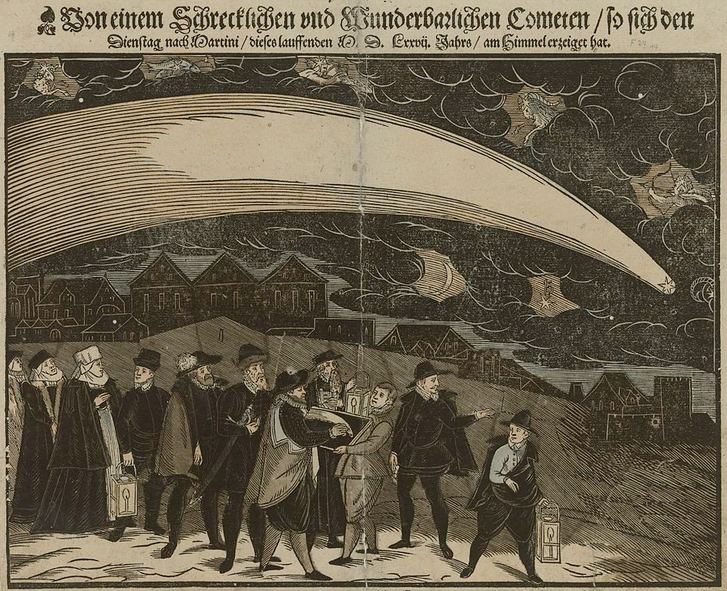
The Great Comet of 1577, following a mere 5 years later, was highly visible and observed by many, including Tycho Brae.

Dee’s Angelic revelations included 48 tables out of 49…
[Dee’s Angelic revelations included 48 tables out of 49, the 49th being reserved. Separately, the Volnich manuscript has a possible key on the 49th-numbered sheet. ]
A quire of paper is a measure of paper quantity. The usual meaning is 25 sheets of the same size and quality: 1⁄20 of a ream of 500 sheets. Quires of 25 sheets are often used for machine-made paper, while quires of 24 sheets are often used for handmade or specialised paper of 480-sheet reams. (As an old UK and US measure, in some sources, a quire was originally 24 sheets.) Quires of 15, 18 or 20 sheets have also been used, depending on the type of paper.Pasted from <https://en.wikipedia.org/wiki/Units_of_paper_quantity#Quire> The number of sheets in a ream has varied locally over the centuries, often according to the size and type of paper being sold. Reams of 500 sheets (20 quires of 25 sheets) were known in England in c.1594; in 1706 a ream was defined as 20 quires, either 24 or 25 sheets to the quire. In 18th- and 19th-century Europe, the size of the ream varied widely. In Lombardy a ream of music paper was 450 or 480 sheets; in Britain, Holland and Germany a ream of 480 sheets was common; in the Veneto it was more frequently 500. Some paper manufacturers counted 546 sheets (21 quires of 26 sheets). J.S. Bach’s manuscript paper at Weimar was ordered by the ream of 480 sheets. In 1840, a ream in Lisbon was 17 quires and 3 sheets = 428 sheets, and a double ream was 18 quires and 2 sheets = 434 sheets; and in Bremen, blotting or packing paper was sold in reams of 300 (20 quires of 15 sheets). A mid-19th century Milanese-Italian dictionary has an example for a risma (ream) as being either 450 or 480 sheets.Pasted from <https://en.wikipedia.org/wiki/Units_of_paper_quantity#Quire>
Dee’s Angelic language….
[Dee’s Angelic language. He wasn’t crazy and he was the right man for the job. It just hasn’t panned out. Unless you consider mathematics as the Angelic language. Then it has.]
“According to Tobias Churton in his text The Golden Builders, the concept of an Angelic or antediluvian language was common during Dee’s time. If one could speak with angels, it was believed one could directly interact with them.”Pasted from <https://en.wikipedia.org/wiki/Enochian>
“Mathematics directs the flow of the universe, lurks behind its shapes and curves, holds the reins of everything from tiny atoms to the biggest stars.”
Love and Math: The Heart of Hidden Reality
By Edward Frenkel
Mathematics has been a vocation… John Dee
[Mathematics has been a vocation and a devotion for millenia, but not a full time job. Even in John Dee’s time, there wasn’t enough need for it and the Queen didn’t (wouldn’t) pay for it. He lent his services to navigation, surveying, astronomy/astrology and probably encryption, but he couldn’t get a full-time job as a mathematician, even in academia. It wasn’t until the scientific/technological revolution really got going that mathematics became so critical. But for those who had been initiated into it, it has long been an occult key to the Universe and secret knowledge–the “Book of God.”]
From Wikipedia:
Rigorous arguments first appeared in Greek mathematics, most notably in Euclid’s Elements. Since the pioneering work of Giuseppe Peano (1858–1932), David Hilbert (1862–1943), and others on axiomatic systems in the late 19th century, it has become customary to view mathematical research as establishing truth by rigorous deduction from appropriately chosen axioms and definitions. Mathematics developed at a relatively slow pace until the Renaissance, when mathematical innovations interacting with new scientific discoveries led to a rapid increase in the rate of mathematical discovery that has continued to the present day.
Galileo Galilei (1564–1642) said, “The universe cannot be read until we have learned the language and become familiar with the characters in which it is written. It is written in mathematical language, and the letters are triangles, circles and other geometrical figures, without which means it is humanly impossible to comprehend a single word. Without these, one is wandering about in a dark labyrinth.”
Carl Friedrich Gauss (1777–1855) referred to mathematics as “the Queen of the Sciences”. Benjamin Peirce (1809–1880) called mathematics “the science that draws necessary conclusions”. David Hilbert said of mathematics: “We are not speaking here of arbitrariness in any sense. Mathematics is not like a game whose tasks are determined by arbitrarily stipulated rules. Rather, it is a conceptual system possessing internal necessity that can only be so and by no means otherwise.” Albert Einstein (1879–1955) stated that “as far as the laws of mathematics refer to reality, they are not certain; and as far as they are certain, they do not refer to reality.” French mathematician Claire Voisin states “There is creative drive in mathematics, it’s all about movement trying to express itself.”
From <https://en.wikipedia.org/wiki/Mathematics>
For those who are mathematically inclined, there is often a definite aesthetic aspect to much of mathematics. Many mathematicians talk about the elegance of mathematics, its intrinsic aesthetics and inner beauty. Simplicity and generality are valued. There is beauty in a simple and elegant proof, such as Euclid’s proof that there are infinitely many prime numbers, and in an elegant numerical method that speeds calculation, such as the fast Fourier transform. G.H. Hardy in A Mathematician’s Apology expressed the belief that these aesthetic considerations are, in themselves, sufficient to justify the study of pure mathematics. He identified criteria such as significance, unexpectedness, inevitability, and economy as factors that contribute to a mathematical aesthetic. Mathematicians often strive to find proofs that are particularly elegant, proofs from “The Book” of God according to Paul Erdős.
Selections from an essay on the role of mathematics in English universities
[Selections from an essay on the role of mathematics in university education. As a mathematician – among other things – John Dee was well regarded, but remained unemployed because (in part) of limited opportunity. At the same time, as a mathematician and an intellectual, he was treated with suspicion by the general populace. Poor students worked very hard for advancement, while the sons of the gentry passed through onto their entitlements and privileges. Both John Dee and Christopher Marlowe (mid to late 16th C.) went through as poor scholars.]“At the beginning of the 16th century mathematics and the mathematical sciences were of minor importance in the two English universities. In theory, mathematics had a place in the university curriculum through the quadrivial arts of arithmetic, geometry, astronomy and music, but in practice the then traditional curriculum found little space for their teaching.”“In addition to these institutional changes, contemporaries noted a gradual but pronounced shift in the social composition of the student body. The stereotype of the student as a poor scholar for whom university was a path to vocational (usually ecclesiastical) advancement was challenged by the presence of increasing numbers of sons of the gentry.”“…At both Oxford and Cambridge, mathematics had a place on the margins of these reforms.”“…Certainly, English university provision appeared weak and provincial when compared with the reformed universities of Germany, for example. Under Melanchthon’s leadership, the quadrivial arts (and especially astronomy) were given new institutional impetus by the creation of full professorships.”Pasted from <http://www.mhs.ox.ac.uk/staff/saj/thesis/introduction.htm#section2> Chapter 1 (pp. 1-49) of Stephen Johnston’s , “Making mathematical practice: gentlemen, practitioners and artisans in Elizabethan England.” Ph.D. Cambridge, 1994.Pasted from <http://www.mhs.ox.ac.uk/staff/saj/thesis/introduction.htm#section2>